
How the Iran War is Reorienting Indo-Pacific Security Arrangements
The military escalation starting on February 28, 2026, marks a clear break in the
global security system. It challenges the long-standing US strategy toward the
Indo-Pacific. What began as Operation Epic Fury-a coordinated series of
US-Israeli strikes aimed at dismantling the Iranian leadership- has transformed
into a systemic shock that shifts the maritime and geopolitical order of Asia.
This conflict does more than distract the United States. Rather, it alters the
strategic calculus regarding China and India, linking the critical energy
chokepoint of the Strait of Hormuz with the protection of the Strait of
Malacca.
For twenty
years, the Malacca Dilemma was China’s main strategic concern. Beijing feared
that the US Navy could cut off its economy by blocking the narrow passage
between Indonesia and Malaysia. To counter this, China invested heavily in the
Belt and Road Initiative and in overland routes such as the China-Pakistan
Economic Corridor. However, the 2026 Iran War revealed a bigger issue, that is the
Hormuz Imperative.
The link
between Hormuz and Malacca shifts from a transit vulnerability to an origin
vulnerability. Malacca is a transit chokepoint that can be bypassed via the
Sunda or Lombok Straits. Hormuz, however, remains a terminal maritime
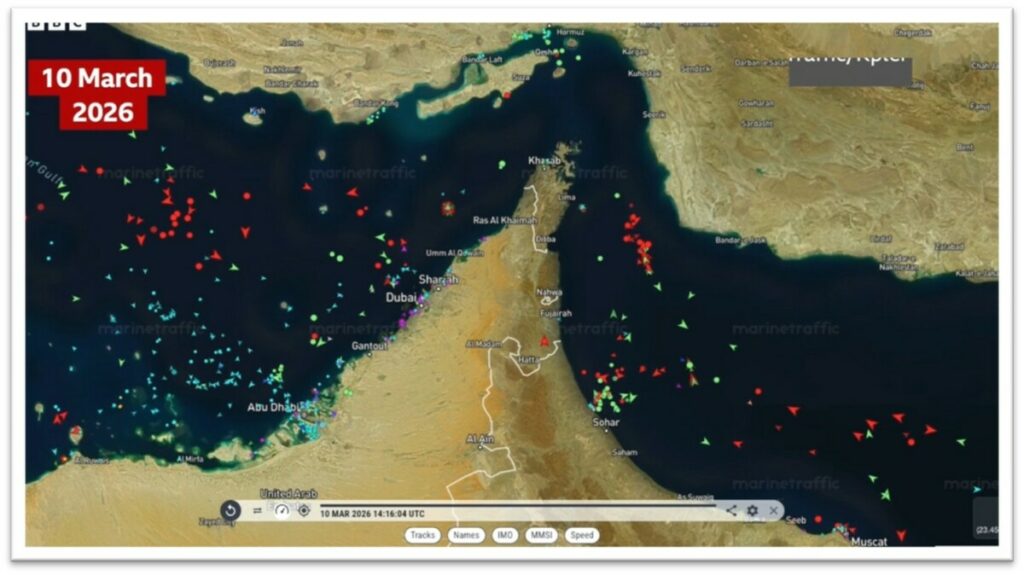
chokepoint. About half of China’s crude oil imports come from the Persian Gulf.
When Hormuz was effectively shut down on March 2, 2026, vessel traffic dropped
to just 8 percent of normal levels. The message was clear: controlling sea
lanes is pointless if the origin point is under total blockade.
This
breakdown prompted China to take aggressive actions in the Strait of Malacca.
As the Persian Gulf became a Hormuz Trap, Beijing’s reliance on energy flow
from Africa and Russia increased. Overland routes like the Myanmar-Yunnan
pipeline operated at only 420,000 barrels per day, while a tiny fraction of the
normal 6.5 million barrels was shipped via Malacca. China now sees the Malacca
Strait not as a dilemma to avoid, but as a critical gateway that must be
defended to prevent any residual energy flows from being cut off by unilateral
US action.
The 2026
Iran War exposed a so-called interceptor gap in the Western Pacific. Tehran’s
strategy of asymmetric exhaustion, which is to deploy $20,000 Shahed drones to
force the US to deplete $500,000 worth of Patriot and THAAD interceptors,
drained US defense accumulated during the pacing challenge of China. US
interceptor stocks were running low, with new THAAD units not expected until
2030.
For
Beijing, this created a 3- to 4-year window. The People’s Liberation Army Navy
(PLAN) shifted from a defensive Anti-Access/Area Denial posture to one of
offensive power projection. The deployment of the Type-09V guided missile
nuclear submarine last February exemplified this shift. These 9,000- to
10,000-ton vessels, armed with hypersonic YJ-19 anti-ship missiles, threaten US
carrier defense from ranges beyond current US anti-submarine warfare
capabilities. The DF-27 missile added a third layer to China’s strategy,
capable of striking US bases in Hawaii and Guam with conventional weapons. This
eliminated the “sanctuary” status of US reinforcement bases, forcing
Washington to focus on defending its home territory rather than interdiction
efforts in the region.
This war
is projecting an end to multilateral maritime security in the Indian Ocean. The
Trump administration, in its 2026 National Defense Strategy, advocates for burden-sharing
and at the same time emphasizes unilateral US naval dominance. This Rough Rider
approach sees the US Navy acting alone to secure chokepoints and impose
sanctions, often bypassing regional partners.
Early-2026
operations (Aquila 2, Veronica 3, and Bertha), involving boarding a group of
tankers (some of which were sanctioned) in the Indian Ocean after tracking them
from the Caribbean, undermine the purpose of the Quad for collective security.
Regional allies like Japan and South Korea, noticing US assets diverted to the
Middle East, begin doubting US reliability in the Pacific, creating a
significant credibility gap.
India’s
strategy to be the Net Security Provider in the Indian Ocean Region (IOR),
outlined in doctrines like SAGAR (2015) and MAHASAGAR (2025), appears illusory
in 2026. New Delhi aimed to promote its navy as the preferred security partner.
The sinking of the Iranian frigate IRIS Dena on March 4, 2026, marked the end
of Indian influence. The frigate was torpedoed by a US submarine just 40
nautical miles off Sri Lanka, India’s maritime backyard, days after
participating in the India-hosted multilateral exercise Milan 2026. US action,
carried out without India’s consent or knowledge, damaged perceptions of
India’s role in protecting the IOR.
India’s
response is projecting a shift from principled neutrality to strategic
paralysis. This reflects its inability to project power against external
threats. Ironically, the US gave India a 30-day window to buy Russian oil,
highlighting India’s low standing in the global energy system. This loss of
guardianship relates to broader shifts: as the US moves toward unilateralism
and China adopts aggressive power projection, India is increasingly sidelined
as a reactive power.
As a
result, the small littoral states in the indian Ocean
region are gaining leverage to hedge against indian
guardianship. That means the war and the Trump administration’s Indo-Pacific
strategy are making the smaller nations in the region active participants in
dealing with pressures stemming from the system level. Countries like
Bangladesh are moving to achieve a proactive foreign policy approach since
August 2024 which is a by-product of the US’s policy shift to engage actively.
Though there is a risk of falling into a bandwagon trap, Bangladesh opts to have
a passive hedging approach while sustaining its sovereign interests.
This trend
has a spillover effect as the other smaller nations in the region are also
projected to pursue a foreign policy stance, choosing between the US and China,
with little bargaining leverage to pursue an active hedging strategy. But the
Iran War sends a shockwave to the global economy, as the great powers have
little to do with the other nations’ interests, which makes the nations
entrapped.
The Iran
war has triggered a crisis spreading from the Persian Gulf to South Asia’s old
conflicts. On February 27, 2026, Pakistan declared an open war on the Taliban
government in Afghanistan with an operation called Ghazab
lil – Haq (Righteous Fury). This involved air strikes
on Kabul and Kandahar aimed at suppressing cross-border attacks by the Taliban,
led strategically by Pakistan.
Iran’s
weakened state has led to ungoverned spaces in Sistan-Balochistan, encouraging
attacks by the separatists
Baloch Liberation Army (BLA) on Chinese personnel
and infrastructure. These overlapping crises have rendered the China-Pakistan
Economic Corridor, once the backbone of the Belt and Road Initiative,
unsustainable. Armed with nuclear weapons and facing instability on all
frontiers, Pakistan has become a liability after serving as a strategic gateway
for Chinese influence.
The Iran
war has altered the global security landscape, making it clear that there is no
insulation in the Indo-Pacific from the Middle East instabilities. China’s long-term
plan to avoid the Malacca Strait dilemma has been disrupted by the reality of
the Hormuz Imperative, forcing a more aggressive maritime approach toward the
Malacca entrance. With the US leaning toward unilateralism and India’s role
becoming contradictory, the maritime status quo has shifted toward prolonged
instability. The interceptor void now invites a great power clash in the East,
where old rules of regional dominance and multilateral cooperation no longer
apply. The Indo-Pacific enters a period of diminished deterrence, where the
struggle for control over key maritime chokepoints will be part of an even
larger fight for survival.
Author’s Bio: Nazmul Islam Mahmud is a Research Assistant at Bangladesh
Institute of Peace and Security Studies (BIPSS). The views are personal.