
What Operation EPIC FURY Taught about
Access, Basing, and Overflight
Brendan
Donnelly | May 24th, 2026
Operation EPIC FURY, the Israeli-American coordinated campaign executed from February
to April 2026, was designed to dismantle the Iranian regime, decimate Iran’s
nuclear capability and maintain freedom of navigation for commerce through the
Strait of Hormuz (SoH). While the operation’s
strategic objectives were clear it has also acted as one of modern days greatest examples of multi-domain operations and events
for academia to draw lessons from for any future conflict. The decade’s first
example with Russia’s campaign in Ukraine, identified lessons regarding the use
of drone warfare and ground operations, while Operation EPIC FURY is a prime
example for the use of conventional naval and air power. One of the most
important lessons that can be taken from the last few months impacted both the
United States Navy (USN) and United States Air Force (USAF), this being the
criticality of what is known as Access, Basing and Overflight (ABO). While this
concept is essential to surface based air power, either on land or sea, it
shares a commonality between the West Asian theater and Eastern Asian theater.
The lesson of ABO taken from Operation EPIC FURY can directly impact any
military operations conducted in the Indo-Pacific theater.
During
the few months of conflict ABO has fluctuated for the U.S. military as access
has been impacted by Iranian efforts in the SoH,
basing has been under daily assault by Iranian drones
and ballistic missiles and overflight has shifted with the diplomatic
relationships with Arabic nations around Iran. Access to the SoH and the Gulf of Oman (GoO) is
essential for the USN, namely the USS Gerald R. Ford and USS Abraham
Lincoln Carrier
Strike Groups (CSG), so that sea-based aircraft can support land-based air
packages from other basing locations in the area. Throughout the operation U.S.
forces have used the same bases they have been for the last thirty years as
many of them were previously used in combat during Operation DESERT STORM and
following Global War on Terror. Thus, the Iranians could easily identify where
to launch counter attacks to deal the most damage to the Israeli-American
military forces. These bases included a total of 18 separate U.S. military
sites, but the major hubs were Al Udeid Air Base (Qatar), Prince Sultan Air
Base (Saudi Arabia), Ali Al Salem Air Base (Kuwait), Al Dhafra Air Base (UAE), Camp
Victory (Iraq), and Muwaffaq Salti Air Base (Jordan). These six key bases were
not only the locations where the USAF concentrated their air assets,
but were the primary targets for Iranian retaliation.
At
the start of U.S. combat operations against Iran in late February, it was
essential for U.S. CSGs to have access to the SoH and
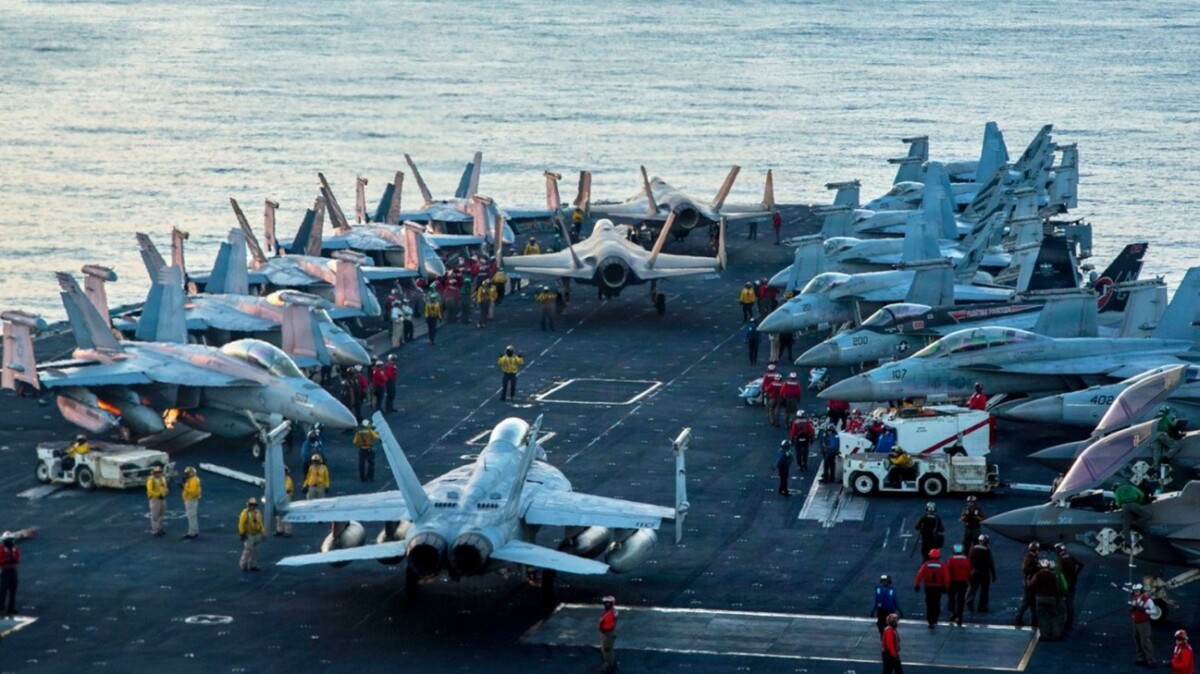
GoO, as sea-based aircraft like the F/A-18 Super
Hornet, F-35C Lightning II, E-2 Hawkeye are some of the essential aircraft
assisting with both kinetic strikes in Iran and command and control of strike
packages. While the CSGs did have access to the SoH
and GoO, permitting their aircraft to operate within
100 nautical miles from Iran, this state of operation is near impossible when
translated to the East and South China Seas (ECS/SCS). Iran during Operation
EPIC FURY could only threaten U.S. naval assets with long range drones and
volleys of ballistic missiles, the Peoples Liberation Army (PLA) in maintains
an inventory of DF (land launched), JL (submarine launched) and PL (air
launched) missiles that can threaten not only large naval vessels but high
valued air assets as well. These capabilities significantly push back any naval
asset hundreds of nautical miles to ensure survival against these advanced
missile systems, degrading any ability by sea-based aircraft to participate in
strike operations within the theater.
While
access in the Indo-Pacific theater will be challenged, Operation EPIC FURY has
also identified the lesson about dispersed land-based airpower. As mentioned,
the U.S. massed aircraft between six primary bases in the theater. Each of
which have experienced daily ballistic missile volleys from Iran and drone
attacks from Iran proper or Iranian Aligned Militia Groups (IAMG) restricting
aircraft from taking off safely and conducting strike packages to target launch
locations within Iran. Just as it was clear where the U.S. was massing airpower
in the West Asian theater, so too will it be evident in the Indo-Pacific
theater. Notably some of the U.S. bases near China include naval and air bases
in Japan, South Korea and the Philippines, all of which would be seriously
threatened by PLA close range missiles and military capabilities. This
connection demands that any military force operating within the Indo-Pacific
theater must learn from Operation EPIC FURY and prepare their force to counter
the “glass cannon paradox”. By this it means that any force needs to be able to
maximize offensive output while also sustaining the ability to defend itself
from an adversary onslaught.
Regarding
overflight, defined as “permission for military aircraft to pass over a
specific country or territory” has been tenuous during Operation EPIC FURY.
Each location that U.S. aircraft are based they also require overflight
authorized by the host nation just to take off. Countries like Saudi Arabia,
Jordan, Iraq, UAE and Qatar have adjusted their stance with the U.S. as any
acceptance of U.S. military aircraft taking off from within their borders to
then strike Iran places significant diplomatic pressure on these nations.
Additionally, it forces host nations to accept retaliatory strikes from drones
and ballistic missiles increasing the risk to civilians and national
infrastructure. While overflight has been fluid across the Arabic nations, in
the Indo-Pacific, the Association of Southeast Asian Nations (ASEAN) may also
play a significant role in the theater. ASEAN stands resolute that the
countries within this diplomatic organization do not choose sides between the
U.S. and China nor seek warfare so to preserve the economic growth of the
organization. This means that any nation seeking overflight of nations such as
the Philippines, Thailand, Vietnam, Malaysia or their territorial waters for
combat operations against China may be diplomatically restricted. Thus, placing
an additional burden for any operations in the theater as a direct lesson from
the last few months of conflict against Iran.
Each
of these areas of concern, military access to the battlespace, military basing
around the operating area, and overflight for air transit, are significant
lessons drawn from Operation EPIC FURY. The lesson that modern navies must
adjust from a more permissive area allowing naval access, to a significant
geographic distance for naval vessels is challenge never seen in modern
conflict. The lesson that modern militaries must sustain a force that does not
fall to the “glass cannon paradox” pressuring significant investment in
military capabilities for both offense and defense simultaneously,
and further pressuring modern military leadership to accept more risk
than originally comfortable. The lesson that diplomacy is even more critical during
the use of military force to maintain overflight is an aspect of military
operations not previously thought of as a significant issue. Each of these
lessons combined identifies how Operation EPIC FURY has taught lessons about ABO,
and how ABO as a concept is a standing requirement. And it is imperative that
any military forces observe how these challenges have impacted U.S. operations
in their current theater, and how they can translate to other theaters around
the globe.
The views expressed in this article are
the personal views of the author and do not necessarily reflect the views of
the Department of War, the Department of the Air Force, or the U.S. Government.