
America’s
21st Century Raiders: Punitive
Expeditions and Counter Terrorism Doctrine Reformed
By: Grant T. Willis, Capt., USAF | May 31st, 2026
“Let us admit it fairly, as a business people should,
We have had no end of a lesson: it will do us no end of good.”
—The Lesson, by Rudyard Kipling (1901) [1]
Defining
the Threat
America’s enemies
will always have a vote. Whether we
unilaterally declare a war finished or proclaim victory, the enemy will only
accept defeat when THEY decide to.
Ceasefires, pull outs, or withdrawals do not serve as definitive ends to
irregular wars while our enemies continue to pursue hostilities against us
regardless of our timetables. The nature
of Violent Extremist Organizations (VEOs) is to play a longer game than our
society has the attention span for, and they’re determined to harm our citizens
at every opportunity. Regardless of this
determination amongst America’s enemies, our mentality as a nation tends to
wish for a clear beginning, middle, and end of its wars. In the counterinsurgency game, a clear
ending, like the last page of a book is often elusive and leads to
disillusionment and an exhausted national will to carry on an “endless” or
“forever” war. Indeed, the terrorist
threat to America is an endless and forever state of being, and the capacity
and necessity to meet that challenge is likewise never-ending.
Although we
continue to prepare our conventional forces for battle against Russia or China,
there will be, for the foreseeable future, non-state entities which seek to harm
our citizens at home and interests abroad.
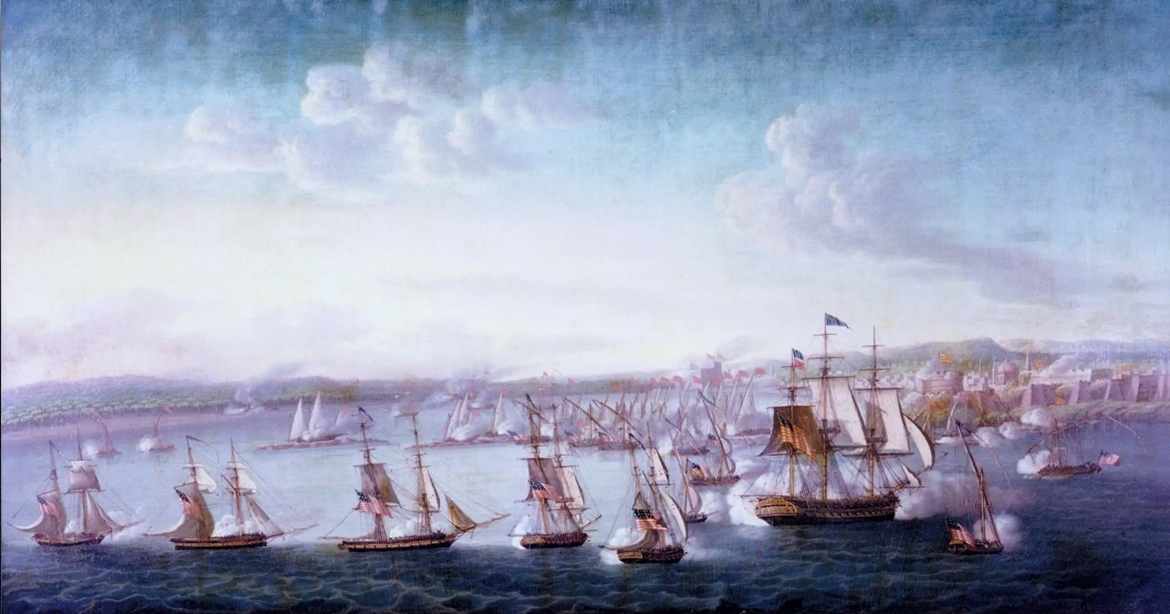
From the birth of our nation, VEOs have sought to make war on the United
States, starting with the Barbary States as early as 1785, when Berber corsairs
under the Pasha of Algeria began a series of attacks upon American merchant
vessels transiting the Mediterranean.[2] As a result of multiple years of Islamic
state sponsored pirates taking vessels, their cargo, and forcing American
sailors into slavery, Congress authorized bribes to the Barbary despots. The payoffs and their sums continued to
rise. The First Nation to officially declare
war on the United States after 1783 was the barbary state of Tripoli in 1801,
after a large bribe was requested by the Pirates and refused by the Jefferson
administration. The previous
administrations of George Washington and John Adams had acquiesced to the
Berber demands, but by 1801 Jefferson would not.[3] Punitive military action against the states
of Algeria, Tunis, and Tripoli required the establishment of the U.S. Navy in
1794 to project power abroad against the first enemy of the new Republic,
Islamic fundamentalists. The 1794 Naval
Act begins by stating,
“WHEREAS the
depredations committed by the Algerine corsairs on the commerce of the United
States render it necessary that a naval force should be provided for its
protection…”[4]
After years of
paying handsome bribes, the sword acted as a corrective instrument against state
sponsored piracy by Islamic radicals who used their interpretation of the Quran
as an excuse to attack “non-believers”.
Jefferson also sought to rescue American citizens held as slaves, and
secure freedom of maritime navigation. Navy
squadrons brought themselves under the guns of the great fortifications of
Algiers, Tunis, and Tripoli, braved the Berber Corsairs in battle, and inserted
special forces teams of Marines and sailors to build internal allies by, with,
and through to defeat the enemy and bend them to our terms. The small American teams marched hundreds of
local partner irregulars to Barbary strongholds, and with American audacity,
led them to victory over the marauders.
Supported by the mobile guns of the American squadrons offshore, the
famous line of the Marine Corps hymn, “…to the shores of Tripoli” was coined by
these 18th century versions of Green Berets or MARSOC Raiders. When the Tripolitan city of Derna fell, the
Stars and Stripes flew, for the first time, over enemy soil abroad.[5] Not to remain or occupy for decades building
a new government in our image, but to inspire the world to stand up to a
tyranny which no one before dared to confront, execute corrective action, and
withdraw without quagmire. Punitive
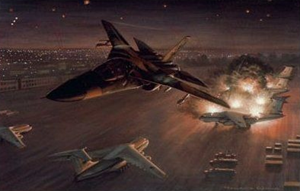
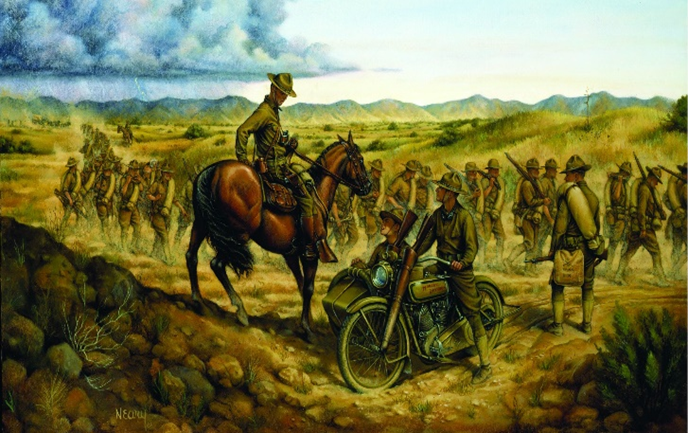
campaigns are commonplace throughout our history such as the Battle of the
Pearl River Forts in 1856[6], The
U.S. Expedition to Korea in 1871[7], The Mexican
Expedition of 1916 to 1917[8], The
Mayaguez incident in 1975[9],
Operation Urgent Fury 1983[10], Bekkaa valley Strikes in 1983[11], Operation
El Dorado in 1986[12], Operation Praying Mantis in 1988[13],
Operation Infinite Reach in 1998[14], Operation
Desert Fox in 1998[15], Operation
Odyssey Lightning in 2016[16], the 2018
U.S. strikes on Syria[17], Operation
Rough Rider in 2025[18], and
Operation Midnight Hammer in 2025[19], just
to name a few.
|
 |
 |
The American
populace and their post Global War on Terror (GWOT) sentiments of “war
weariness” have resulted in a lack of will to support involvement in the long
and costly process of nation building through expeditionary counterinsurgency.[20] The U.S. Military must embrace a different
doctrine and course of action to mitigate the threat from organizations bent on
doing us harm while also retaining public support for limited military action.
The American
political system dictates civilian control and leadership over the military.[21]
That civilian authority is exercised by political leaders who are commissioned
by the people of the United States to govern on their behalf. If the
people are dissatisfied with their leaders, they exercise their electoral power
through elections. Those political leaders are then put out of a job by
their dissatisfied constituents. Therefore, that vital variable in the
exercise of military force by civilian leadership is the consent and support of
our citizens. To ignore the opinion of the majority of the population is to
slip into a compounding military hubris.
Author and naval historian Ian W. Toll wrote of our
founding fathers’ earliest anxieties in committing the young American Republic
to a long and endless struggle against radical Islam. Toll recounts an
exchange between John Adams and Thomas Jefferson on the prospects of engaging
the Barbary States writing,
…Adams did not
believe the American people or their leaders were ready either to rebuild the
navy or to fight a war in the Mediterranean. ‘We ought not to fight them at
all,’ he wrote, unless we determine to fight them forever. This thought is, I
fear, too rugged for our People to bear.’ The more likely outcome, Adams
predicted, would be that the United States would fight for years at great
expense, only to pay for peace in the end. He concluded with the pessimistic
thought that the entire debate was irrelevant. Congress was so weak and
indecisive, he told Jefferson that it would not be capable of doing anything at
all about the Barbary threat: I perceive that neither Force nor Money will be
applied… your Plan of fighting will no more be adopted than mine of
negotiating.’ No effective response to the problem was possible, short of
sweeping constitutional reform to correct the deficiencies of American
government.”[22]
Upon reflection,
many modern observers could view Adams’ and Jefferson’s points as rather
prescient.
In On War, Prussian
Military theorist Carl von Clausewitz states, “No one starts a war – or rather,
no one in his senses does so – without first being clear in his mind what he
intends to achieve by the war and how he intends to conduct it. The former is the political purpose; the
latter its operational objective…the political object-the original motive for
the war-will thus determine both the military objective to be reached and the
amount of effort it requires.”[23] In this maxim lies the primary duty of
military professionals to assist in shaping civilian leaders’ political
objectives and the necessary measure to achieve them without lazily moving the
goalposts of those objectives. It was
James Madison ghost writing as Publius, in Federalist 10 who
wrote, “Enlightened statesmen will not always be at the helm…”[24] To clearly define the nature of the enemy and
type of warfare to be fought will produce the force structure needed to meet
the political objectives or challenge the feasibility of those objectives if
they cannot be won through a military campaign.
To execute
global Counter Terrorism (CT) operations post-GWOT, the United States MUST take
the time to frame the nature of the problem.
American citizens, reeling from the failures in Iraq and Afghanistan,
will only accept low costs, short durations, and high precision. The costs of such ventures will always be
counted and skeptically reported. It is
vital that our professional joint warfare practitioners define the nature of
the CT fight as it stands today. CT
professionals must weigh the supporting population’s perceptions at home and
design a force capable of meeting our national security objectives with those
public perceptions in mind. American
citizens’ wishes will dictate how the military is used by elected officials;
therefore, the military must adapt its force structure to be able to strike
anytime anywhere without flirting with quagmires and igniting “forever war” or
“war weariness” hysteria amongst the public.[25]
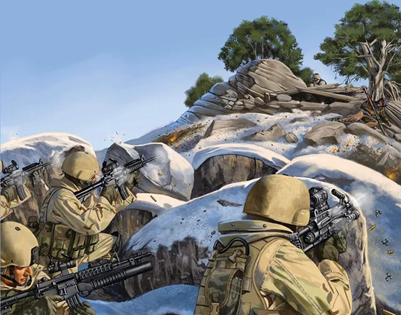
In the aftermath
of the 9/11 attacks by Al-Qaeda, public demands for retaliation sparked a punitive
expedition to Afghanistan, but despite initial success against AQ and the
Taliban with light losses, the war grew into a nation building adventure and
counterinsurgency prompting several administrations with competing or often
unclear objectives, sinking deeper into the sands of immeasurable progress
resulting in a humiliating withdrawal in August 2021 and ultimate Taliban
victory through forfeit.
Definitions Define the War
If the above
circumstances are generally correct, what kind of CT warfare must the United
States engage in? The answer lies within
the Punitive Expedition: unrelenting, mobile, and undeterred lightning bolts
struck from the sea, land, and air against far off enclaves and sanctuaries of VEOs
within the nations whose own internal disintegration has allowed these groups
to grow unimpeded. Free to train,
organize, plot, and export violence, these VEO’s can exercise the freedom of
maneuver offered through the chaos found in “failed states”. Our navy provides us with the ability to
exercise joint CT fires in ways many nations can only dream of wielding.
It is
fundamental for understanding this corollary to CT operations by comprehending
the differences between counterinsurgency and counter terrorism. This is not to say that counter insurgency
should be neglected. Valuable lessons in
the execution of effective COIN operations have been won through great blood
and sacrifice.[26] However, executing American-led
counterinsurgencies abroad is not on the bucket list of most American citizens
after Iraq and Afghanistan and the political nightmare of convincing the public
to not draw upon the “forever war” syndrome is a battle many may find difficult
to master while retaining office.
The following definitions are necessary
to understand:
– Counterinsurgency
(COIN) is a comprehensive effort to detach insurgents or rebels from the local
community and methods of sustainment and support.[27]
– Counter
terrorism (CT) is best defined by Fabiana Natale as “Activities and operations
taken to neutralize terrorists, their organizations, and networks in order to
render them incapable of using violence to instill fear and coerce governments
or societies to achieve their goals.”[28]
– A punitive expedition is a military
or other forceful action undertaken to punish a group, entity, or individual
for perceived wrongdoings, often outside the territory of the punishing power.
It’s a display of force meant to exact retribution, deter future misbehavior,
or exert diplomatic pressure, rather than a full-scale war.[29]
Modern CT
campaigns could be compared to the well-known historical military practice of
so-called “Punitive Expeditions” and are often criticized as “ineffective” at
dealing with the real problem of eradicating the ideology from the society it
came. But within many post-GWOT civil
populations, we do not necessarily wish to invest in that counter-ideological
effort through the long and costly adventures counterinsurgency produces. That sentiment leaves professional CT forces
with few other realistic options.
Another
consideration for the future is that we may not have the same basing access or
enduring presence we have enjoyed in the post-WWII global order. Troop drawdowns, domestic political
decisions, and geopolitical events may drive American CT assets, once
permanently based, out of regions which allow VEOs to grow in strength and
organization without a continuous CT presence and pressure. Some locations may not allow the U.S. basing
access or diplomatic clearances to carry out kinetic actions or overflights
against groups found hostile in the vicinity of those host nations who wish to
not draw attention to themselves or invite domestic or geopolitical
complications. The current status quo is
not guaranteed. As the fluidity of geopolitics and domestic demands shape
foreign policy, the US must adapt its CT forces NOW to be ready to operate in
defense of its citizens tomorrow. One of
our most unparalleled capabilities is our expeditionary projection through
joint air and naval forces. Joint maritime mobility and its organic air power
will grow in demand as well as its CT value.
With all the
variables of the problem laid out above, the solution to maintaining a force
capable of executing short, intense, and precise CT campaigns is the Joint
Counter Terrorism Raiding Force (JCTRF) concept. The JCTRF utilizes some of the most valuable
combinations of joint capabilities possible.
These being the size of our Navy, its mobility, and the lethal joint nature
of our special forces.
One of the major
victories of the GWOT era are the lessons learned by American commando units
and their supporting assets. The battles
fought through GWOT to post-GWOT have taught America’s joint forces invaluable
lessons when combating terror groups and hybrid non state actors possessing
everything from the AK-47 to kamikaze drones.
The threat these increasingly well-armed groups pose is not going away any
time soon.
The Solution and Order of Battle
To execute raiding
operations and achieve our objectives, we must be mobile and hard-hitting. To be mobile against the safe havens of these
groups, we must take notes from our ancestors who fought this sort of enemy in
the early 19th Century with cannon and shot.
We must strike from the mobility offered to us by the sea. An effective and limited CT campaign with the
intent to precisely raid enemy concentrations in their sanctuaries can be done
from offshore. The JCTRF’s primary
mission is to set sail on short notice as a totally self-sufficient force,
bring striking power across the globe whenever or wherever it is needed to quell
VEOs, and significantly set them back.
This force, composed of joint special operations forces with
capabilities on air, land, and sea, can project precise and overwhelming
firepower. The force would consist of a
naval task force comprising the following:
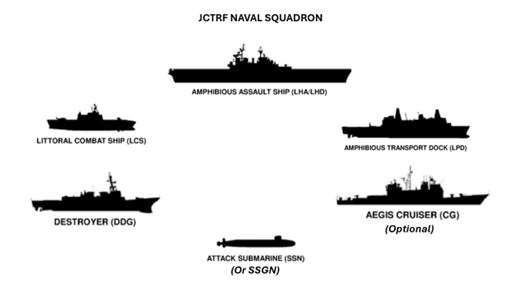
Onboard the LHA or “SOF Carrier”, the
air component supporting this force would comprise the following:
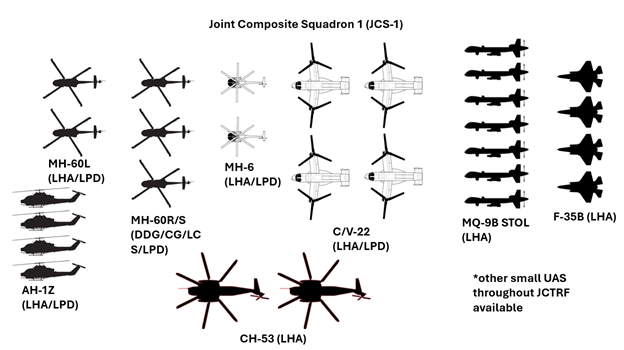
The airmobile direct action and special
reconnaissance elements would include the following units:
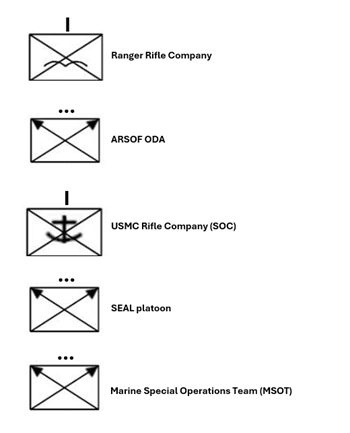
The authorities would reside with a
naval flag officer with the following:
Strike cell and joint
operations center (JOC) on board with delegated target engagement authority (TEA),
commanded by an O-6 or O-7. A 1 star or 2-star Admiral in overall joint command
of JCTRF naval task force co-located with the JOC.
This joint
mobile unit would act with all logistics and fire support self-contained with
the intent to sustain continuous combat operations for 30 to 45 days. Re-supply and re-fueling could be completed
at sea after a brief pause in combat operations with a resumption required by the
National Command Authority (NCA).
The JCTRF would
set off towards its intended target organization, hit them hard in their base
areas, and return to their home station ready to re-coil like a ready spring to
execute again if necessary. Like a
continuous game of “whack a mole”, the Raiding Force would train together and
deploy together as a joint team, ready to respond unilaterally, if necessary,
to any hot spot in which VEOs or non-state actors seek to challenge or threaten
the United States.
We cannot take
overseas basing for granted when planning to sustain an over-the-horizon strike
capability. Stealth bombers may be able
to perform long-range global strike, but this process is long and requires
multiple refueling aircraft who must station themselves from land bases along
the intended strike route. Diplomatic
clearances and agreements for basing should always be cultivated to ensure
forward basing, but it is not a variable we can assume will exist across the
globe forever. Large nuclear aircraft carrier
strike groups require multiple escorts, and their aircraft have limited on-station
times, and lack counter terror specialized assets to maintain persistent SOF
strike ISR. Unmanned, light weight, long
endurance remotely piloted aircraft like the MQ-9 are still required to sustain
precise kinetic fires on VEOs. The Find,
Fix, Target, Track, Engage, and Assess (F2T2EA) method continues to be the
cornerstone of aerial CT warfare.
Bringing long on-station times (long amount of time over target) and precision
strike ISR to SOF task forces while limiting the need to place American
personnel in harm’s way will only increase in demand.
Long transit
times equal shorter on-station times, which leads to a lack in coverage and
limited windows for strikes. Many
nations utilize MQ-9 variants, old and new, but none have the same reputation
of frequency of use as the United States for their employment as strike
platforms against VEOs in combat. To
adapt the capabilities of the MQ-9 to a more modern mobile CT force which does
not require the same level of diplomatic allowances taken for granted today, we
must look at carrier-based aviation upgrades to ensure that hard-fought and proven
tactics do not fade away due to land-based limitations.
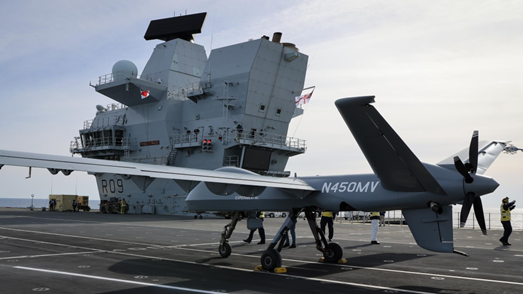
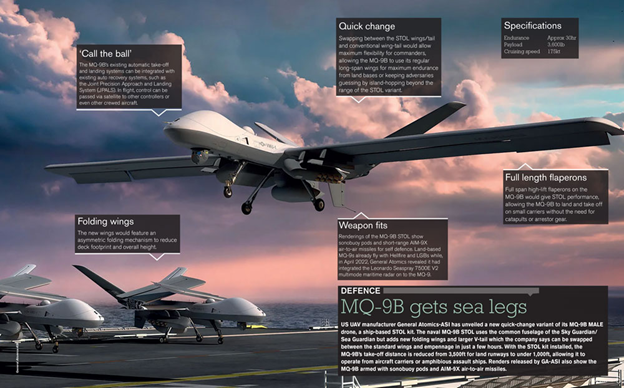
Luckily, for the
JCTRF concept, General Atomics (GA) has established and proven capabilities in
their recent upgrades to the MQ-9 in the form of a carrier capable MQ-9B Short Take-Off
and Landing (STOL) variant.[30] The
MQ-9B STOL allows for foldable wings and is designed to be launched and
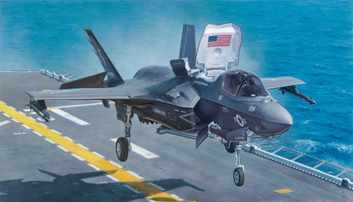
recovered from amphibious assault ships or “helicopter carriers”.[31] The air component for a SOF raiding force off
a hostile coast could allow for a mobile air base, allowing for everything a
SOF campaign would require, from unmanned strike ISR to rotary and fixed wing
stealth fighters in the form of Marine Corps F-35Bs or AV8Bs. The air component of this force will be
supplemented by long range weapons and naval gunfire from surface escorts in
the form of surface and subsurface launched Tomahawk Land Attack
Cruise Missiles (TLAMs). The direct action and special reconnaissance elements
can utilize the LHA and LPD for their staging and supply source, employing
rotary aviation for insertion, extraction, CSAR, PR, and CAS on top of carrier
MQ-9s and Marine VTOL fighters. An
accompanying nuclear submarine (SSN attack or SSGN guided missile) can provide
significant strike options, SLUAS capabilities, covert insertion, and maritime
interdiction.
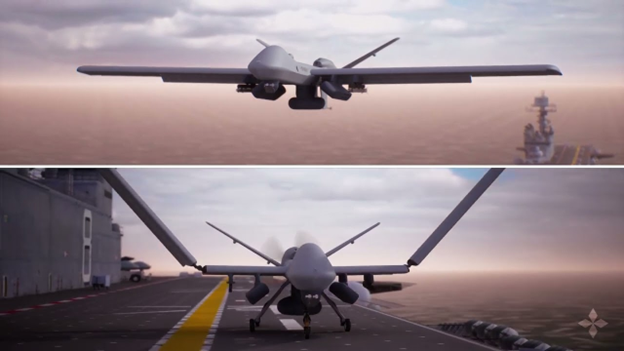
The Raiding
Force’s maritime mobility creates more difficulty in targeting solutions for hybrid
weapons which may be employed by an enemy VEO.
Whether it may be Anti-Ship Ballistic Missiles (ASBMs), Anti-Ship Cruise
Missiles (ASCMs), Uncrewed Vessels, or One Way Attack Unmanned Aerial Systems
(OWAUAS), the naval squadron can provide localized air defense, Defensive Counter
Air (DCA) and/or Advanced Precision Kill Weapon System (APKWS) used by rotary or
fixed wing aircraft.[32]
With all strike
capabilities from air, land, and sea contained within the JCTRF, the command
element can exercise intent with a pre-set series of known targets prior to the
execution of any D-Day as well as set dynamic targets in accordance with a Joint
Priority Targeting List (JPTL). There
are several scenarios in which the JCTRF can effectively employ its
capabilities as a “Punitive Expedition”.
Many enemy sanctuaries are established within failed states or nations unable
to control their territory in the presence of an organized VEO or non-state
entity with the intent to establish training areas, recruitment stations,
command and control (C2), and weapons storage.[33] If a group establishes a safe haven to plot,
train, and carry out external operations against our homeland, the United
States must have a mobile CT force that can unilaterally take decisive action
in our nation’s defense to set hostile organizations back and force them to
internally focus their efforts to sustain their own survival.
What It May Look Like In
Action: Operation Askari Lightning, October 24th – November 22nd,
2031[34]
*The following scenario is one of
fiction and introduces a hypothetical scenario in which the United States could
effectively utilize the JCTRF concept. The story is of the author’s
conception and is not based on any ongoing or previous operations nor does it
necessarily represent the views and opinions of the U.S. War Department or any
of its components.
A country in
Africa, with a coastline, suffers for years under a brutal military
dictatorship. Several dissident groups formed in rebellion against the
government. Years of tribal differences
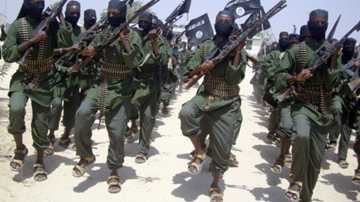
have split the population’s loyalties and civil war begins. A radical Islamist element has taken root and
declared its allegiance to another well-known terrorist organization hostile to
the west and the United States. As the regime
struggles to maintain control over population centers, large areas of the
countryside allow for the establishment of significant base areas for the new terror
group and their patrons to move in with young foreign fighters to gain combat
experience and training. The VEO’s
leadership makes proclamations across social media outlets calling for Jihad
against the United States. Religious
leaders issue calls or “fatwas” for suicide attacks against Americans at home
and abroad.
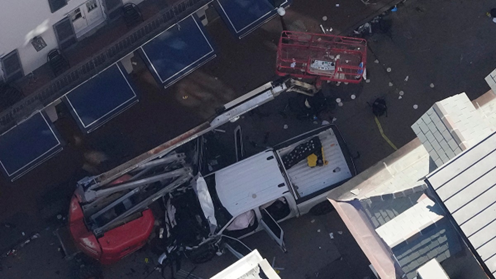
A vehicle ramming
attack against a street festival in an American Midwestern city is perpetrated by
an individual who was motivated by online correspondence with VEO members who
used an advanced AI software messaging system which identified and managed radicalization
communication and coordination for targetable individuals. The terror group from the failing African
state, in their base area, executed their plans through an organized cyber
network to inspire, fund, and coordinate homegrown attackers.[35] 14 Americans
are dead, 10 injured, and 2 are in critical condition. Intelligence methods reveal to the President that
more attacks are planned, and training is active to take fighters from their
sanctuary in the failed African state and bring them into the U.S. Domestic agencies are hard at work to find
and roll up known or suspected networks.
The time for action against the source of the attack is now.
The National Security Council (NSC) is
assembled and the news media debates on what actions should be taken. Many Americans are infuriated and demand
action, but a great debate erupts across the traditional media outlets and on
social media with congressional representatives and influencers making their
cases for either action or caution.
Podcast hosts and news anchors flash memories of Afghanistan and Iraq
and cite a “war weariness” amongst the population to not get involved in yet
another so-called “forever war”. Polling
shows a call for retribution, but a lack of stomach or will to put “boots on
the ground” or send money, arms, and advisors to support the brutal military regime
which faces consistent global condemnation for its brutality. The Congress is under majority control by the
opposition party to the President and options to insert ground units to occupy
closer airfields are deemed as “getting involved in another Iraq or
Afghanistan”. The President is between a
rock and hard place.
Several options
are presented to the NSC and President. There are no land bases other nations
in the vicinity will allow the U.S. to launch strikes from in the area and long-range
bombers must fly from the United States on 24+ hours requiring multiple
refueling stages. The bombers can reach
the target area but cannot sustain a very long on station time. Certainly not
long enough to precisely strike any High Value Individuals (HVIs) with a low
collateral weapon in a populated area without high civilian casualties. To do
that you need a long loiter time in the overhead and an asset that can employ
lower collateral systems to maintain precision over multiple days of persistent
surveillance. These bomber strikes would
be limited to known targets only and could not prosecute dynamic
opportunities. The nuclear-powered CSGs
are committed to deterrence operations in the Pacific and Europe while others
are undergoing maintenance and training.
The other option
is to send the 1st Joint Counter Terror Raiding Force. After the JCTRF’s capabilities are presented
in detail to the president’s NSC, the decision is unanimous.
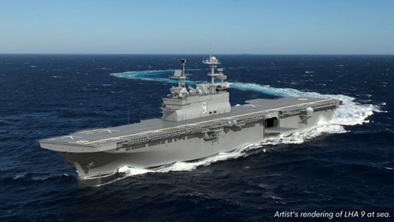
The 1st JCTRF,
centered around the America Class Amphibious Assault ship, USS Fallujah
LHA-9[36], is
underway, executing a combined NATO exercise off Portugal when orders arrive
for all activity to cease and to rapidly sail for somewhere off the African
coast, making all preparations for the sustainment of combat operations for at
least 30 days. Fallujah and her escorts
rapidly kick into gear. The 6 months of
pre-deployment joint training will now be tested. Mission planning cells spin up, and intelligence
and targeting packages are approved and updated. Coordination with space and cyber assets
within the force and in the United States is stepped up. The Rear Admiral in command addresses the
Raiding Force and a call from the President is broadcast to all units of the
force. A “Punitive Expedition” black
pirate flag, specially made for the 1st JCTRF is hoisted above the
flagship. Days later, the American
squadron arrives off the coast of the target territory. The final execution order to commence
Operation Askari Lightning now sits with the President. The order is given by the President, “Execute. Godspeed and good luck. America is with you.”
The first TLAMs
are fired by the SSGN accompanying the force against fixed targets including
barracks, weapons storage sites, C2 nodes, and training facilities. On board the deck of the Fallujah,
MQ-9Bs are spotted (prepared) and 4 are launched. The first “Sea Reaper” is a modified airborne
early warning (AEW) variant capable of acting as the task force’s airborne controller.[37] One after the other, Air Force Special
Operations Command (AFSOC) crews operating the MQ-9s remotely from the United
States utilize Satellite Launch and Recovery (SLR’s) Automated Take-Off and Landing
from the LHA’s deck with one launched every 15 minutes.[38] The
last MQ-9B launches and turns towards the shore retracting its landing
gear. After the MQ-9s launch, 2 Marine F-35Bs
are launched with mixed air to air and air to ground loadouts to perform DCA
and Dynamic Targeting (DT) as required.[39] Hours before the TLAMs launched special
reconnaissance teams of Marine Raiders and a U.S. Navy SEAL platoon infiltrated
enemy territory by sea and by low level rotary wing insertion, slipping past
any early warning infrastructure of the weak regime forces.[40] The 2nd SEAL team onboard stands ready
alongside the soldiers of a rifle company of the 3rd Ranger Battalion to act as
a Quick Reaction Force (QRF).[41] AH-1Z “Vipers” and AH-6 “Little Birds” stand
ready to be brought on deck at short notice should their launch be required.
The first TLAMs impact
on their targets, sending the enemy VEO into confusion. The MQ-9s, now in the overhead, began to
prosecute dynamic targets. 2 of the
AFSOC operated MQ-9Bs are carrying Small Cruise Missiles (SCMs) just in case
any regime Surface to Air Missile (SAM) sites go active.[42] The State Department, shortly after the first
TLAMs impact VEO targets, delivers a message to the military government stating
our intent to target only anti-regime extremist forces and any resistance to
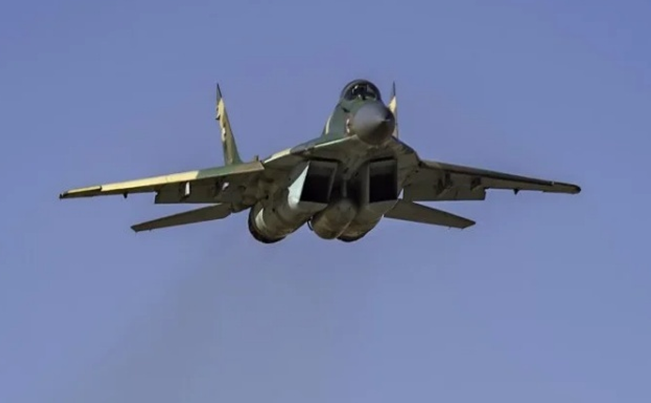
American action will be confronted with defensive force. In the confusion of the strikes and a fever
of anti-American interventionism, 2 of the 10 available MiG-29 “Fulcrum”
fighters of the regime scramble and vector towards our MQ-9s. The MiGs activate their target engagement
radars. DCA F-35Bs launch 2 x AIM-120
advanced medium range air to air missiles (AMRAAM) beyond visual range (BVR), destroying
both MiGs.[43]
|
 |
 |
|
 |
 |
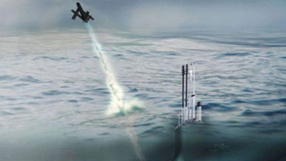
Meanwhile, a Submarine-Launched
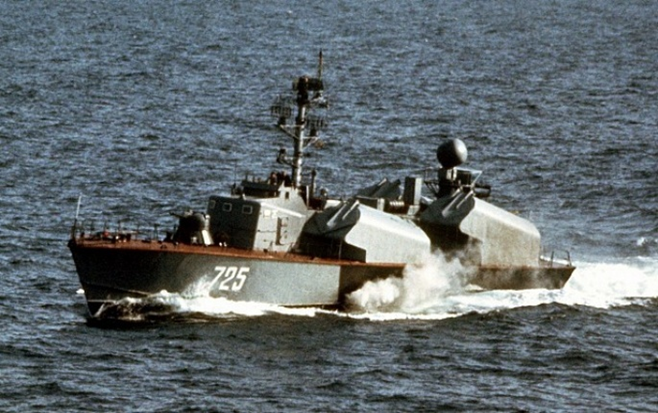
Unmanned Aerial System (SLUAS) tracks the main regime naval base near the
capital and identifies 2 ex-Soviet Osa Class missile boats leaving harbor,
turning towards the American Squadron offshore.[44] The missile boats actively use their maritime
search radars and open their missile doors on either side of the boats, “Styx”
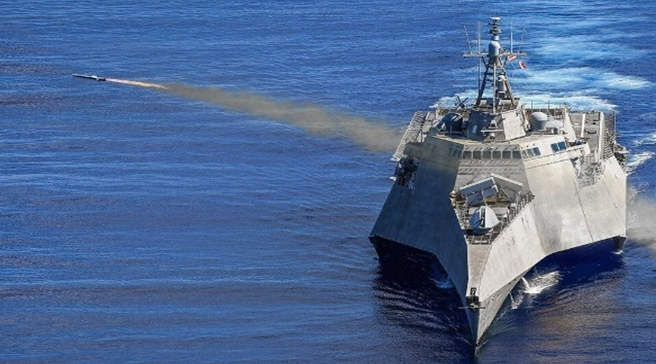
ASCMs at the ready. The DDG’s combat
information center (CIC) uses the real time footage from the SLUAS loitering
above to confirm positive identification (PID) of the boats and quickly
launches 2 naval strike missiles (NSM) at the lead Osa. The LCS launches 2 NSMs on the 2nd Osa.[45] Both boats execute evasive maneuvers and
deploy chaff, to no avail. Both missile
boats receive direct hits and explode.
The regime forces stand down.
An MQ-9B tracks
a suspicious covered truck to a coastal location. The truck stops and a group of military aged
males begin to uncover and set up a one-way attack drone launch battery. The MQ-9B’s feed is displayed in the JOC
onboard the Fallujah. The MQ-9B is out of weapons due to a previous
engagement. The task force commander has
other assets committed to action and aircraft are cleared from the deck of the
LHA due to recovery operations. The
commander makes a snap decision to send the LCS escorting the task force on a
run to use its Mark 110 57mm gun against the enemy battery.[46] Target coordinates are relayed real time by
the AFSOC crew of the MQ-9B to the LCS’ CIC.
Once within 8 nautical miles from the enemy, the LCS opens fire. Several rounds impact near the position with
corrections called by the MQ-9B. The
rounds kill all enemy combatants and associated equipment.
The VEO begins
to take heavy losses, including a 3D printing drone factory located inside a
cave complex.[47]
On day 3 of the campaign, most of the known targets are eliminated and any
remaining leadership targets have gone to ground in a desperate attempt to
avoid elimination. A sustained counter
leadership air campaign takes place and all special recon ground elements are
withdrawn via rotary wing assets. No
American special operators were killed with 2 wounded in action (WIA) from a
suicide vest detonated on a direct-action mission. In return, by day 6 of the campaign, 250+
enemy combatants were killed in action, an unknown number of wounded, and all
approved targets on D-1 were destroyed.
4 one-way attack drones were launched at the American naval squadron
offshore and all 4 were intercepted by a combination of AH-1Z APKWS and F-35B
AIM-9X sidewinders.[48] By D+30, the VEO base area has been cleared
of all known enemy locations and the organization command structure crippled. 2 direct action (DA) missions resulted in 4
enemy detainees, and the destruction and exploitation of 2 terror cyber
facilities from which foreign recruitment efforts for attacks against the
homeland were coordinated. On D+31, the
1st JCTRF was ordered to cease hostilities and return home. The Punitive Expedition and the first combat validation
of America’s “Raiding Doctrine” passed its first test. The VEO was crippled and faced increasing
pressure from its nearby enemy on the ground amid the ongoing civil war. Its sanctuary was no more, and a long period
of rebuilding and new leadership was required before they could contemplate
external attacks on America. But that
was okay, because in a few years, if they regained strength, a new operational
plan based on lessons learned from Operation Askari Lightning would be brought
to bear against them once more. After
replenishing at sea, the 1st JCTRF returned to their home port on the Atlantic
Coast for a much-needed dwell period. USS
Tripoli LHA-7 and the 2nd JCTRF set sail a few weeks later to take over
alert status for any other contingency. America’s
Raiders had set back a global Jihadist network and sanctuary for years at a low
cost. No further attacks on the homeland by that group were assessed as “imminent”
by the intelligence community (IC).
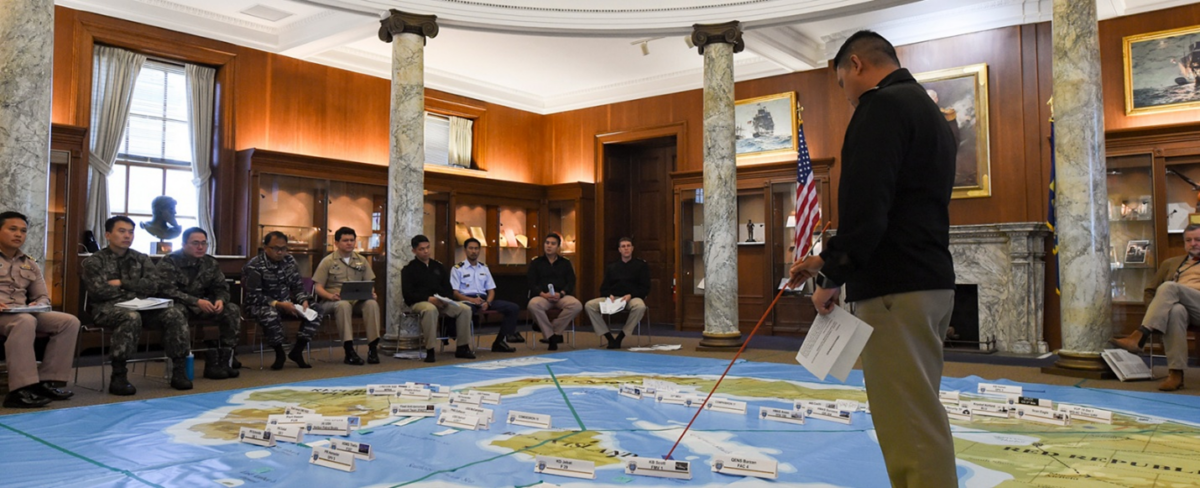
Upon intensive
debrief and lessons learned sessions, several joint officers executed a joint
roadshow to present the key takeaways of the campaign to service war colleges
and assisted in revisions based on operational realities to the Joint
Publication associated with the employment of a JCTRF.
Conclusions and Ways Ahead
We must be
prepared to return repeatedly, if necessary.
If a terror sanctuary moves to a new failed state or ungoverned
territory, so does the Raiding Force.
Had the post 9/11 2001-2002 campaign against Al-Qaeda (AQ) and their
Taliban hosts been executed like a Punitive Expedition, we may have seen the
successful demonstration of modern Raiding counter terrorism doctrine,
retaining the force posture needed to reset and strike again wherever the
terrorist threat expanded.[49]
If a conflict in
the Pacific seems probable, the task force can return to home port, swapping
its mission configuration to become a “Lightning Carrier” of F-35Bs and set
sail as a second echelon of naval aviation to support any in theater CSGs and
sister America or cousin Wasp class ships in an effort to battle
any struggle against communist aggression in the Indo Pacific.[50] Furthermore, the JCTRF can be tasked for
action against great power outposts outside the adversary nation’s
expeditionary reach, subduing far off enemy garrisons outside the primary
combat area along the strategic periphery.
The greatest
aspect to the JCTRF concept is that all the technology and units required to
make up the task force’s order of battle already exist. The combination of the various units and
assets and joint training can be accomplished with the execution order from
military and political leadership to make it happen. This process would not be easy and a new
doctrinal methodology for joint war fighting would be needed along with
dedicated joint training between those units who would take part in such a
force. Congressional advocacy and higher
military support for this concept can and should be accomplished to dedicate
the funding re-allocation required to make such a force a reality.
It is necessary for joint military professionals to foresee the day in
which our global basing is not what it once was, and our population’s will to commit
to large military adventures against VEOs in far off lands diminished. It is only prudent to structure our counter
terrorism forces accordingly for such a possibility to be able to defend the
American people without acting against their tolerance.
We may be
done with terrorism, but the terrorists are not done with us.

Author Bio:
Captain Willis is an Air Force Special
Operations Command (AFSOC) pilot and research and writing fellow with the
Consortium of Indo-Pacific Researchers’ military history team. He is a distinguished graduate of the
University of Cincinnati’s Air Force ROTC program with a BA in international
affairs and a minor in political science. His work has appeared in United
States Naval Institute’s Naval History, Air University’s Journal
of Indo-Pacific Affairs, Air University’s Wild Blue Yonder Journal, Air
Commando Journal, and Nova Science Publishing.
Bibliography:
Kipling, Rudyard. “‘No End
of a Lesson’: The Boer War, 1899-1902.” “No end of a lesson”: The Boer War,
1899-1902 – National Portrait Gallery, 2014. https://www.npg.org.uk/whatson/display/2014/no-end-of-a-lesson-the-boer-war-1899-1902.
Fremont-Barnes, Gregory. The
wars of the Barbary pirates: To the shores of tripoli:
The rise of the US navy and Marines. London: Osprey Publishing, 2014.
“NH 85796 ‘an Act to Provide
a Naval Armament.’” Naval History and Heritage Command, 1794. https://www.history.navy.mil/our-collections/photography/numerical-list-of-images/nhhc-series/nh-series/NH-85000/NH-85796.html.
Buse, H.W. “The Barrier
Forts.” Historical Branch G3 Division USMC HQ Washington DC, 1962. https://www.usmcu.edu/Portals/218/HD%20MCUP/HD%20Pubs/Barrier_Forts.pdf?ver=2019-02-01-113425-563.
“Salee River, Korea – 1871.”
National Museum of the Marine Corps. Accessed July 15, 2025. https://www.usmcmuseum.com/uploads/6/0/3/6/60364049/salee_river.pdf.
“Punitive Expedition in
Mexico, 1916-1917.” U.S. Department of State. Accessed July 14, 2025. https://2001-2009.state.gov/r/pa/ho/time/wwi/108653.htm.
Chun, Clayton K. S. The
Last Boarding Party: The USMC and the SS Mayaguez, 1975. Oxford, UK: Osprey
Pub, 2011.
Ball, Gregory. “1983 –
Operation Urgent Fury.” Air Force Historical Support Division, 1997. https://www.afhistory.af.mil/FAQs/Fact-Sheets/Article/458952/1983-operation-urgent-fury/.
Carroll, Ward. “This Botched
Air Strike on Lebanon Changed Naval Aviation Forever.” We Are the Mighty, April
2, 2018. https://www.wearethemighty.com/articles/this-botched-air-strike-on-lebanon-changed-naval-aviation-forever/.
Ball, Gregory. “1986 –
Operation El Dorado Canyon.” Air Force Historical Support Division. Accessed
July 14, 2025. https://www.afhistory.af.mil/FAQs/Fact-Sheets/Article/458950/1986-operation-el-dorado-canyon/.
Vego, Milan. “Determining
Political Objectives.” Joint Forces Quarterly, no. 116 (2025).
Zimmer, 2Lt, USMC. “The
Tanker War.” U.S. Naval Institute, April 30, 2025. https://www.usni.org/magazines/naval-history/2025/june/tanker-war.
Newsweek Staff. “‘Our Target
Was Terror.’” Newsweek, July 1, 2010. https://www.newsweek.com/our-target-was-terror-169580.
Ball, Gregory. “1998 –
Operation Desert Fox.” Air Force Historical Support Division. Accessed July 14,
2025. https://www.afhistory.af.mil/FAQs/Fact-Sheets/Article/458976/1998-operation-desert-fox/.
Ritter, Joe. “MQ-9s over
Sirte: Unmanned Airpower for Urban Combat – Modern War Institute.” Modern War
Institute -, March 23, 2022.
https://mwi.westpoint.edu/mq-9s-over-sirte-unmanned-airpower-for-urban-combat/.
Diplomatic Room. “Statement
by President Trump on Syria.” National Archives and Records Administration,
2018. https://trumpwhitehouse.archives.gov/briefings-statements/statement-president-trump-syria/.
Hummel, Kristina. “Feature
Commentary: An Assessment of Operation Rough Rider.” Combating Terrorism Center
at West Point, June 26, 2025. https://ctc.westpoint.edu/feature-commentary-an-assessment-of-operation-rough-rider/.
Vergun, David. “Defense Agency Contributed toward Operation
Midnight Hammer Success.” U.S. Department of Defense, July 10, 2025. https://www.defense.gov/News/News-Stories/Article/Article/4240876/defense-agency-contributed-toward-operation-midnight-hammer-success/.
Jamie Ballard Data. “Do
Americans Think the Bombing of Iran and Other U.S. Foreign Military
Interventions Were the Right Decisions?” YouGov, July 7, 2025. https://today.yougov.com/politics/articles/52495-do-americans-think-the-bombing-of-iran-was-the-right-decision.
We The People. “Full Text of
the U.S. Constitution.” National Constitution Center – constitutioncenter.org,
1787. https://constitutioncenter.org/the-constitution/full-text.
Walldorf, William. “Why the
American Public Is More War-Weary than Ever.” Time, January 31, 2024. https://time.com/6590408/us-biden-middle-east-war/.
Owens, Mackubin.
“Counterinsurgency from the Bottom up: Colonel H.R. McMaster and the 3rd
Armored Cavalry Regiment in Tel Afar, Spring-Fall 2005.” Foreign Policy
Research Institute, March 24, 2017. https://www.fpri.org/article/2017/03/counterinsurgency-bottom-colonel-h-r-mcmaster-3rd-armored-cavalry-regiment-tel-afar-spring-fall-2005/.
Natale, Fabiana. “Choosing
the Right Strategy: (Counter)Insurgency and (Counter)Terrorism as Competing
Paradigms.” The Security Distillery, December 12, 2019. https://thesecuritydistillery.org/all-articles/choosing-the-right-strategy-counterinsurgency-and-counterterrorism-as-competing-paradigms.
Benson, Kevin. “Bringing
Back the Punitive Expedition.” Marine Corps Association, December 16, 2019. https://www.mca-marines.org/wp-content/uploads/Pros-Cons-The-Punitive-Expedition-200116.docx.
Lariosa, Aaron-Matthew.
“U.K. Carrier HMS Prince of Wales Launches, Recovers Mojave Drone.” USNI News,
November 17, 2023. https://news.usni.org/2023/11/17/u-k-aircraft-carrier-hms-prince-of-wales-launches-recovers-mojave-drone.
Dan Parsons, Tyler Rogoway.
“New Kit Will Allow MQ-9 Reaper to Fly from Navy Flattops.” The War Zone, May
10, 2022. https://www.twz.com/new-kit-will-allow-mq-9-reaper-to-fly-from-navy-flattops.
“Bell AH-1Z – Attack and
Reconnaissance Helicopter Engineered for the Extreme.” Bell Flight. Accessed
July 14, 2025. https://www.bellflight.com/products/bell-ah-1z.
NCTC. “Terrorist Groups:
National Counterterrorism Center.” Terrorist Groups | National Counterterrorism
Center. Accessed July 14, 2025. https://www.dni.gov/nctc/groups.html.
Shelbourne, Mallory. “Big
Deck Amphibs Bougainville, Fallujah Delayed, Budget Docs Say.” USNI News, July
9, 2025. https://news.usni.org/2025/07/09/big-deck-amphibs-bougainville-fallujah-delayed-budget-docs-say.
“FBI Statement on the Attack
in New Orleans.” FBI National Press Office, January 1, 2025. https://www.fbi.gov/news/press-releases/fbi-statement-on-the-attack-in-new-orleans.
“Amphibious Assault Ships –
LHD/LHA(R).” United States Navy. Accessed July 14, 2025. https://www.navy.mil/Resources/Fact-Files/Display-FactFiles/Article/2169814/amphibious-assault-ships-lhdlhar/.
Thomas Newdick, Tyler
Rogoway. “MQ-9B Airborne Early Warning Variant Could Fill Major Aerial
Surveillance Gaps.” The War Zone, June 17, 2025. https://www.twz.com/air/mq-9b-airborne-early-warning-variant-could-fill-major-aerial-surveillance-gaps.
“MQ-9 Reaper.” Air Force
Special Operations Command. Accessed July 14, 2025. https://www.afsoc.af.mil/About-Us/Fact-Sheets/Display/Article/2547323/mq-9-reaper/.
“SLR: Creating New Legacy.” Air Combat Command.
Accessed July 14, 2025. https://www.acc.af.mil/News/Article-Display/Article/3377719/slr-creating-new-legacy/.
Arthur, Gordon. “General
Atomics Targets East Asia – and Its Helicopter Carriers – with Its Uavs.” Naval News, June 4, 2025. https://www.navalnews.com/event-news/dsei-japan-2025/2025/06/general-atomics-targets-east-asia-and-its-helicopter-carriers-with-its-uavs/.
Rogoway, Tyler. “Here’s the USMC’s Plan for ‘Lightning
Carriers’ Brimming with F-35Bs.” The War Zone, March 30, 2017. https://www.twz.com/8798/heres-the-usmcs-plan-for-lightning-carriers-brimming-with-f-35bs.
“What We Do.” Marine Raider
Recruiting, March 26, 2025. https://www.marsoc.com/what-we-do/.
“Best Ranger: The United
States Army.” Best Ranger | The United States Army. Accessed July 14, 2025. https://www.army.mil/ranger/.
“NSW.” Naval Special Warfare
Command. Accessed July 14, 2025. https://www.nsw.navy.mil/.
Tucker, Patrick. “Air Force
Special Operations Wants to Fire Cruise Missiles from Reaper Drones.” Defense
One, May 9, 2025. https://www.defenseone.com/technology/2025/05/air-force-special-operations-wants-fire-cruise-missiles-reaper-drones/405210/.
Tirpak, John A., Chris
Gordon, Unshin Lee Harpley, Amanda Miller, Greg
Hadley, Abraham Mahshie, Brian W. Everstine, and
Rachel S. Cohen. “AIM-120 Advanced Medium-Range Air-to-Air Missile (AMRAAM).”
Air & Space Forces Magazine. Accessed July 13, 2025. https://www.airandspaceforces.com/weapons/aim-120/.
“US Navy Tests Submarines’
Ability to Launch Flying Drones.” SOFREP, January 10, 2025. https://sofrep.com/navy/us-navy-tests-submarines-ability-to-launch-flying-drones/.
“Naval Strike Missile.” RTX. Accessed July 13, 2025. https://www.rtx.com/raytheon/what-we-do/sea/naval-strike-missile.
“MK 110 57 Mm Gun.” United States Navy. Accessed July
13, 2025. https://www.navy.mil/Resources/Fact-Files/Display-FactFiles/Article/2167940/mk-110-57-mm-gun/.
Roque, Ashley. “With Push to 3D Print Drones, Army
Examines Battlefield Calculation.” Breaking Defense, July 8, 2025. https://breakingdefense.com/2025/07/with-push-to-3d-print-drones-army-examines-battlefield-calculation/.
Trevithick, Joseph. “Laser-Guided Rockets Shown
Shooting Down Houthi Drones for First Time.” The War Zone, March 19, 2025. https://www.twz.com/air/air-launched-laser-guided-rockets-shown-shooting-down-houthi-drones-for-first-time.
Neville, Leigh. Takur
Ghar: The seals and rangers on Roberts Ridge, Afghanistan 2002. Oxford, UK:
Osprey Publishing, 2013.
Gunn, Kyle. “Lightning Carriers: The Marines’ Secret
Weapon in the Pacific.” Task & Purpose, June 26, 2025. https://taskandpurpose.com/tech-tactics/marine-corps-lightning-carrier-pacific/.
“Founders Online: The Federalist Number 10, [22
November] 1787.” National Archives and Records Administration. Accessed August
16, 2025. https://founders.archives.gov/documents/Madison/01-10-02-0178.
Toll, Ian W. Six Frigates: The Epic History of
the Founding of the U.S. Navy. Chicago: W.W. Norton & Company,
2008.
[1] Kipling, Rudyard. “‘No
End of a Lesson’: The Boer War, 1899-1902.” “No end of a lesson”: The Boer War,
1899-1902 – National Portrait Gallery, 2014.
https://www.npg.org.uk/whatson/display/2014/no-end-of-a-lesson-the-boer-war-1899-1902.
[2] Fremont-Barnes, Gregory. The
wars of the Barbary pirates: To the shores of Tripoli: The rise of the US navy
and Marines. London: Osprey Publishing, 2014.
[3] Fremont-Barnes, Gregory. The
wars of the Barbary pirates: To the shores of Tripoli: The rise of the US navy
and Marines. London: Osprey Publishing, 2014.
[4] “NH 85796 ‘an Act to
Provide a Naval Armament.’” Naval History and Heritage Command, 1794.
https://www.history.navy.mil/our-collections/photography/numerical-list-of-images/nhhc-series/nh-series/NH-85000/NH-85796.html.
[5] Fremont-Barnes, Gregory. The
wars of the Barbary pirates: To the shores of Tripoli: The rise of the US navy
and Marines. London: Osprey Publishing, 2014.
[6] Buse, H.W. “The Barrier
Forts.” Historical Branch G3 Division USMC HQ Washington DC, 1962.
https://www.usmcu.edu/Portals/218/HD%20MCUP/HD%20Pubs/Barrier_Forts.pdf?ver=2019-02-01-113425-563.
[7] “Salee River, Korea –
1871.” National Museum of the Marine Corps. Accessed July 15, 2025.
https://www.usmcmuseum.com/uploads/6/0/3/6/60364049/salee_river.pdf.
[8] “Punitive Expedition in
Mexico, 1916-1917.” U.S. Department of State. Accessed July 14, 2025.
https://2001-2009.state.gov/r/pa/ho/time/wwi/108653.htm.
[9] Chun, Clayton K. S. The
Last Boarding Party: The USMC and the SS Mayaguez, 1975. Oxford, UK: Osprey
Pub, 2011.
[10] Ball, Gregory. “1983 –
Operation Urgent Fury.” Air Force Historical Support Division, 1997.
https://www.afhistory.af.mil/FAQs/Fact-Sheets/Article/458952/1983-operation-urgent-fury/.
[11] Carroll, Ward. “This
Botched Air Strike on Lebanon Changed Naval Aviation Forever.” We Are The Mighty, April 2, 2018.
https://www.wearethemighty.com/articles/this-botched-air-strike-on-lebanon-changed-naval-aviation-forever/.
[12] Ball, Gregory. “1986 –
Operation El Dorado Canyon.” Air Force Historical Support Division. Accessed
July 14, 2025.
https://www.afhistory.af.mil/FAQs/Fact-Sheets/Article/458950/1986-operation-el-dorado-canyon/.
[13] Zimmer, 2Lt, USMC. “The Tanker War.” U.S. Naval Institute, April 30,
2025. https://www.usni.org/magazines/naval-history/2025/june/tanker-war.
[14] Newsweek Staff. “‘Our
Target Was Terror.’” Newsweek, July 1, 2010.
https://www.newsweek.com/our-target-was-terror-169580.
[15] Ball, Gregory. “1998 –
Operation Desert Fox.” Air Force Historical Support Division. Accessed July 14,
2025.
https://www.afhistory.af.mil/FAQs/Fact-Sheets/Article/458976/1998-operation-desert-fox/.
[16] Ritter, Joe. “MQ-9s over
Sirte: Unmanned Airpower for Urban Combat – Modern War Institute.” Modern War
Institute -, March 23, 2022.
https://mwi.westpoint.edu/mq-9s-over-sirte-unmanned-airpower-for-urban-combat/.
[17] Diplomatic Room.
“Statement by President Trump on Syria.” National Archives and Records
Administration, 2018.
https://trumpwhitehouse.archives.gov/briefings-statements/statement-president-trump-syria/.
[18] Hummel, Kristina.
“Feature Commentary: An Assessment of Operation Rough Rider.” Combating
Terrorism Center at West Point, June 26, 2025.
https://ctc.westpoint.edu/feature-commentary-an-assessment-of-operation-rough-rider/.
[19] Vergun, David. “Defense Agency Contributed toward
Operation Midnight Hammer Success.” U.S. Department of Defense, July 10, 2025.
https://www.defense.gov/News/News-Stories/Article/Article/4240876/defense-agency-contributed-toward-operation-midnight-hammer-success/.
[20] Jamie BallardData. “Do
Americans Think the Bombing of Iran and Other U.S. Foreign Military
Interventions Were the Right Decisions?” YouGov, July 7, 2025.
https://today.yougov.com/politics/articles/52495-do-americans-think-the-bombing-of-iran-was-the-right-decision.
[21] We The People. “Full Text
of the U.S. Constitution.” National Constitution Center –
constitutioncenter.org, 1787.
https://constitutioncenter.org/the-constitution/full-text.
[22] Toll, Ian W. Six
Frigates: The Epic History of the Founding of the U.S. Navy. Chicago: W.W.
Norton & Company, 2008. Pg 28.
[23] Vego, Milan. “Determining
Political Objectives.” Joint Forces Quarterly, no. 116 (2025).
[24] “Founders Online: The
Federalist Number 10, [22 November] 1787.” National Archives and Records
Administration. Accessed August 16, 2025.
https://founders.archives.gov/documents/Madison/01-10-02-0178.
[25] Walldorf, William. “Why
the American Public Is More War-Weary than Ever.” Time, January 31, 2024.
https://time.com/6590408/us-biden-middle-east-war/.
[26] Owens, Mackubin.
“Counterinsurgency from the Bottom up: Colonel H.R. McMaster and the 3rd
Armored Cavalry Regiment in Tel Afar, Spring-Fall 2005.” Foreign Policy
Research Institute, March 24, 2017.
https://www.fpri.org/article/2017/03/counterinsurgency-bottom-colonel-h-r-mcmaster-3rd-armored-cavalry-regiment-tel-afar-spring-fall-2005/.
[27] Natale, Fabiana.
“Choosing the Right Strategy: (Counter)Insurgency and (Counter)Terrorism as
Competing Paradigms.” The Security Distillery, December 12, 2019.
https://thesecuritydistillery.org/all-articles/choosing-the-right-strategy-counterinsurgency-and-counterterrorism-as-competing-paradigms.
[28] Natale, Fabiana.
“Choosing the Right Strategy: (Counter)Insurgency and (Counter)Terrorism as
Competing Paradigms.” The Security Distillery, December 12, 2019.
https://thesecuritydistillery.org/all-articles/choosing-the-right-strategy-counterinsurgency-and-counterterrorism-as-competing-paradigms.
[29] Benson, Kevin. “Bringing
Back the Punitive Expedition.” Marine Corps Association, December 16, 2019.
https://www.mca-marines.org/wp-content/uploads/Pros-Cons-The-Punitive-Expedition-200116.docx.
[30] Lariosa, Aaron-Matthew.
“U.K. Carrier HMS Prince of Wales Launches, Recovers Mojave Drone.” USNI News,
November 17, 2023.
https://news.usni.org/2023/11/17/u-k-aircraft-carrier-hms-prince-of-wales-launches-recovers-mojave-drone.
[31] Dan Parsons, Tyler
Rogoway. “New Kit Will Allow MQ-9 Reaper to Fly from Navy Flattops.” The War
Zone, May 10, 2022.
https://www.twz.com/new-kit-will-allow-mq-9-reaper-to-fly-from-navy-flattops.
[32] “Bell AH-1Z – Attack and
Reconnaissance Helicopter Engineered for the Extreme.” Bell Flight. Accessed
July 14, 2025. https://www.bellflight.com/products/bell-ah-1z.
[33] NCTC. “Terrorist Groups:
National Counterterrorism Center.” Terrorist Groups | National Counterterrorism
Center. Accessed July 14, 2025. https://www.dni.gov/nctc/groups.html.
[34] Shelbourne, Mallory. “Big
Deck Amphibs Bougainville, Fallujah Delayed, Budget Docs Say.” USNI News, July
9, 2025.
https://news.usni.org/2025/07/09/big-deck-amphibs-bougainville-fallujah-delayed-budget-docs-say.
[35] “FBI Statement on the
Attack in New Orleans.” FBI National Press Office, January 1, 2025.
https://www.fbi.gov/news/press-releases/fbi-statement-on-the-attack-in-new-orleans.
[36] “Amphibious Assault Ships
– LHD/LHA(R).” United States Navy. Accessed July 14, 2025.
https://www.navy.mil/Resources/Fact-Files/Display-FactFiles/Article/2169814/amphibious-assault-ships-lhdlhar/.
[37] Thomas Newdick, Tyler
Rogoway. “MQ-9B Airborne Early Warning Variant Could Fill Major Aerial
Surveillance Gaps.” The War Zone, June 17, 2025.
https://www.twz.com/air/mq-9b-airborne-early-warning-variant-could-fill-major-aerial-surveillance-gaps.
[38] “MQ-9 Reaper.” Air Force
Special Operations Command. Accessed July 14, 2025.
https://www.afsoc.af.mil/About-Us/Fact-Sheets/Display/Article/2547323/mq-9-reaper/.
“SLR: Creating
New Legacy.” Air Combat Command. Accessed July 14, 2025.
https://www.acc.af.mil/News/Article-Display/Article/3377719/slr-creating-new-legacy/.
Arthur, Gordon.
“General Atomics Targets East Asia – and Its Helicopter Carriers – with Its Uavs.” Naval News, June 4, 2025.
https://www.navalnews.com/event-news/dsei-japan-2025/2025/06/general-atomics-targets-east-asia-and-its-helicopter-carriers-with-its-uavs/.
[39] Rogoway, Tyler. “Here’s the USMC’s Plan for ‘Lightning
Carriers’ Brimming with F-35Bs.” The War Zone, March 30, 2017.
https://www.twz.com/8798/heres-the-usmcs-plan-for-lightning-carriers-brimming-with-f-35bs.
[40] “What We Do.” Marine
Raider Recruiting, March 26, 2025. https://www.marsoc.com/what-we-do/.
[41]“Best Ranger: The United States Army.” Best
Ranger | The United States Army. Accessed July 14, 2025.
https://www.army.mil/ranger/.
“NSW.” Naval Special
Warfare Command. Accessed July 14, 2025. https://www.nsw.navy.mil/.
[42] Tucker, Patrick. “Air
Force Special Operations Wants to Fire Cruise Missiles from Reaper Drones.”
Defense One, May 9, 2025.
https://www.defenseone.com/technology/2025/05/air-force-special-operations-wants-fire-cruise-missiles-reaper-drones/405210/.
[43] Tirpak, John A., Chris
Gordon, Unshin Lee Harpley, Amanda Miller, Greg
Hadley, Abraham Mahshie, Brian W. Everstine, and
Rachel S. Cohen. “AIM-120 Advanced Medium-Range Air-to-Air Missile (AMRAAM).”
Air & Space Forces Magazine. Accessed July 13, 2025.
https://www.airandspaceforces.com/weapons/aim-120/.
[44] “US Navy Tests
Submarines’ Ability to Launch Flying Drones.” SOFREP, January 10, 2025.
https://sofrep.com/navy/us-navy-tests-submarines-ability-to-launch-flying-drones/.
[45] “Naval Strike Missile.”
RTX. Accessed July 13, 2025.
https://www.rtx.com/raytheon/what-we-do/sea/naval-strike-missile.
[46] “MK 110 57 Mm Gun.”
United States Navy. Accessed July 13, 2025.
https://www.navy.mil/Resources/Fact-Files/Display-FactFiles/Article/2167940/mk-110-57-mm-gun/.
[47] Roque, Ashley. “With Push
to 3D Print Drones, Army Examines Battlefield Calculation.” Breaking Defense,
July 8, 2025.
https://breakingdefense.com/2025/07/with-push-to-3d-print-drones-army-examines-battlefield-calculation/.
[48] Trevithick, Joseph.
“Laser-Guided Rockets Shown Shooting down Houthi Drones for First Time.” The
War Zone, March 19, 2025.
https://www.twz.com/air/air-launched-laser-guided-rockets-shown-shooting-down-houthi-drones-for-first-time.
[49] Neville, Leigh. Takur Ghar: The seals and rangers on Roberts
Ridge, Afghanistan 2002. Oxford, UK: Osprey Publishing, 2013.
[50] Gunn, Kyle. “Lightning
Carriers: The Marines’ Secret Weapon in the Pacific.” Task & Purpose, June
26, 2025.
https://taskandpurpose.com/tech-tactics/marine-corps-lightning-carrier-pacific/.