
Japan’s Strategic Shift: From Pacifist
to Provider
August 8th, 2026. | Indu Saxena, Leo Lin, Jose
Custodio, and Chris Kolakowski

On April 21, 2026, Japan crossed a threshold that many
strategic thinkers and analysts once considered inconceivable in Japan’s
security realm. Prime Minister Sanae Takaichi’s Cabinet approved the removal of
Japan’s longstanding ban on lethal weapons exports[1]
— a major shift in its postwar pacifist policy as the country seeks to
build up its arms industry and deepen cooperation with regional partners and
beyond. The decision did not emerge from a vacuum. It is the culmination of a
decade-long strategic transformation driven by a deteriorating security
environment in the neighborhood, recent uncertainty over US security
guarantees, and recognition that deterrence in the Indo-Pacific demands more
than restraint. The article highlights the three intersecting pressures that
drive Japan’s choice of defense equipment cooperation. It emphasizes Japan’s
decision to export arms is not a militarist revival — it is a pragmatic
recalibration by a democratic middle power that has correctly concluded that
deterrence without industrial capacity is diplomacy without credibility.
The Architecture of Restraint — and Its
Dismantling
For nearly eight decades, Japan’s arms export policy was
defined by a self-imposed prohibition. In practice, exports were limited to
five non-lethal categories — rescue, transport, vigilance, surveillance, and
minesweeping — while lethal weapons were excluded due to their incompatibility
with Japan’s exclusively defensive and pacifist principles. The postwar order
demanded that Japan be a consumer of security, not a provider of it.
That
consensus began unraveling under Prime Minister Shinzo Abe.[2]
The 2014 reinterpretation of collective self-defense legislation allowed Japan
to act in defense of allies and participate more meaningfully in foreign
military exercises — a psychological as much as legal shift. Then came December
2022’s landmark trio of security documents, which repositioned Japan’s
strategic posture entirely: procuring long-range missiles to establish a
counterstrike capability and setting a target of 2% GDP defense spending.[3]
Notably, Japan reached that target in 2025 — two years ahead of schedule —
signaling significant political will behind the stated ambition.
The Takaichi
Cabinet took the next major step on April 21, when Japan significantly
overhauled its “Three Principles on Transfer of Defense Equipment and
Technology,” officially allowing the export of lethal weapons to nations
with signed transfer agreements.[4]
Additionally, Takaichi’s vision of the “Updated Free and Open
Indo-Pacific (FOIP)” refers to three priorities
Why Now?
Three intersecting pressures made April 2026 the moment of
decision. The first is China’s military build-up, Japan has been exerting
pressure from Beijing’s military buildup and its assertive actions in the East
China Sea and the South China Sea. More recently, China’s ban of critical
mineral exports to 20 Japanese entities[5]
— including Mitsubishi Heavy Industries — in February 2026, on the pretext that
these firms support Japan’s military, was a pointed economic warning. It
accelerated Japan’s push to reduce strategic dependencies and diversify its
industrial base. Meanwhile, Prime Minister Takaichi’s November 2025 statement
that a Chinese attack on Taiwan would constitute a survival threat to Japan has
become the animating logic of the entire buildup — transforming Taiwan from a
distant concern into an existential one.
The second
driver is US burden sharing, shifting and uncertainty over US security
guarantee. The Iran War has demonstrated that the United States is not an
unlimited security provider. Japan accelerated its military buildup to play
more offensive roles in the face of threats[6]
from China, North Korea, and Russia, recognizing that no single country can
protect its own peace and security alone. With American resources stretched
across the Middle East and a pronounced US focus on the Western Hemisphere,
Tokyo could no longer afford to treat the alliance as an unlimited guarantee.
The third is
industrial. Japan’s domestic defense sector had long been structurally unviable
— confined to supplying only the Self-Defense Force and Defense Ministry,
unattractive to investors, and hemorrhaging contractors. The defense industry
is now one of 17 strategic areas for growth under the Takaichi government. A
growing number of major companies and startups are showing interest, especially
in dual-use goods and drones. Arms exports are thus simultaneously a foreign
policy tool and an industrial policy instrument.
The Strategic Footprint: What Japan Is
Now Selling
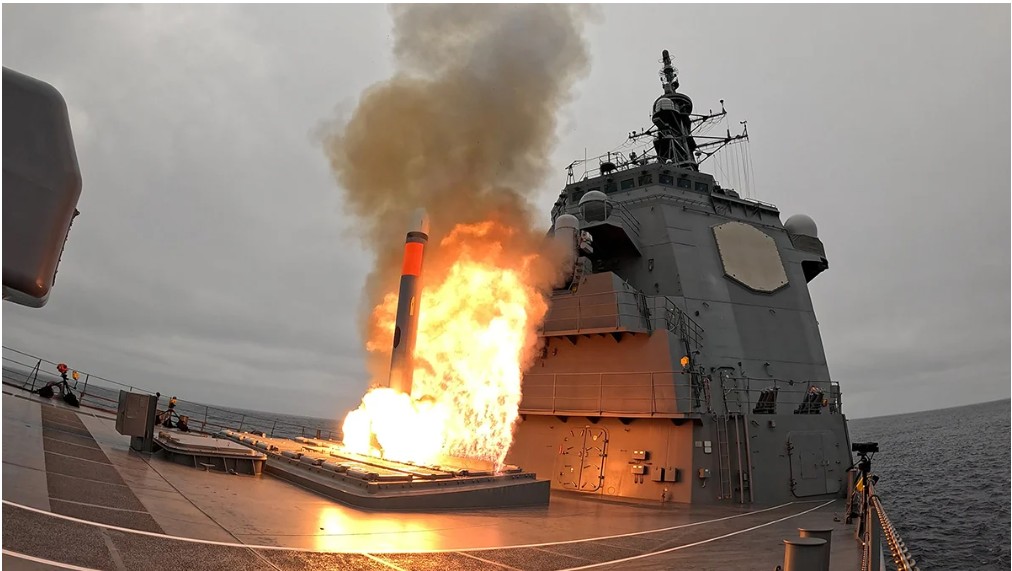
Japan can now export lethal equipment to 17 countries that
it has signed defense equipment and technology transfer agreements with,
including the US, United Kingdom, Australia, and India. The exports permitted
encompasses fighter jets, missiles, submarines, destroyers, and combat drones —
the full spectrum of modern warfighting capability.
The flagship
deal is already visible. Australia signed with Japan for the delivery of three
of Mitsubishi Heavy Industries (MHI) upgraded Mogami-class frigates, with eight
others to be jointly produced, with Australian Defense Minister Richard Marles
welcoming the move as deepening their defense partnership. New Zealand has also
expressed interest, as have the Philippines and Indonesia — countries on the
front lines of South China Sea tension. These expanded sales offer significant
implications for Japan’s involvement with countries in the South China Sea,
Southwest Pacific, and Southeast Asia regions.
Japan and Indonesia
Japan’s defense relationship with
Indonesia has existed within the confines of what is known as white-hull
diplomacy for most of the last two decades.[7]
Japan and Indonesia signed a defense equipment and technology transfer
agreement in March 2021.[8]
However, previously this had mostly been limited to capacity building efforts
such as Japan providing patrol boats for Indonesia’s Maritime Security Agency (Bakamla) and assisting the force with monitoring illegal
fishing and low-level incursions in its territorial waters.[9]
The boats provided under Japanese finance schemes via JICA ranged from 24-meter
and 60-meter class patrol vessels delivered as recently as 2023 but were built
for law enforcement purposes, not naval engagements.[10]
In addition to this, the Japan Coast Guard (JCG) had repeatedly conducted joint
training exercises with Bakamla and its parallel
maritime force, the Indonesian Sea and Coast Guard (KPLP) on search and rescue
operations and anti-smuggling efforts, not high-end combat.[11]
The cooperation resembled that of a status quo power helping a partner with
constabulary duties and not an arms supplier selling weapons to a country
tasked with protecting contested waters.
That has changed in recent years as
Chinese assertiveness of Indonesia’s
Exclusive Economic Zone (EEZ) surrounding the North Natuna Sea has increased.
Chinese fishing fleets accompanied by People’s Liberation Army Navy (PLAN) and
coast guard ships of various types have been repeatedly spotted within
Indonesia’s EEZ around the Natuna Islands, most prominently during the
2019-2020 Natuna incursions.[12]
Indonesia responded to these intrusions by dispatching fighter jets and
warships of its own to the area. Similar incidents happened in 2021, and
Chinese fishing boats have been detained by Indonesian authorities’ multiple
times for illegally fishing within Indonesia’s waters. China’s grey-zone
tactics to challenge Indonesia’s
maritime boundaries without sparking an armed conflict have revealed gaps in
Jakarta’s ability to respond.[13]
While Indonesia has maintained an adequate coast guard presence for many years,
its navy, or the grey-hull deterrence component, has struggled with aging
vessels and a crucial modernization backlog.[14]
Examples of this include Indonesia’s fleet of Ahmad Yani-class frigates, many
of which were commissioned in the 1980s (as former Dutch vessels) and the 2021
KRI Nanggala-402 submarine incident, where an attack submarine suffered from
training and maintenance shortcomings that led to the submarine’s sinking and
the loss of 53 crew members. Indonesia needs asymmetric deterrence that can
impose costs on Chinese coercion, not just document it.[15]
Japan’s removal of the lethal export ban in April 2026 answered this
requirement at a time when Jakarta began exploring its options.[16]
Indonesia’s
plans to acquire six South Korean-built Nagapasa-class
submarines as part of its ongoing effort to replace old-generation submarines
and FREMM frigates from Italy is further evidence of Jakarta’s intentions to
source high-end capability from a range of suppliers.[17]
In 2026, Indonesia has expressed interest in acquiring Mitsubishi Heavy
Industries’ Mogami-class frigates, and with Japan’s new policy in place, any
deal made would not need to be downgraded combat
capabilities and lethal payload to satisfy Japanese export requirements.[18]
If joint production and co-production and offset agreements were made where
some vessels are constructed in Japan and others in Indonesia, it would further
boost Indonesia’s Defense Industrial Base (DIB). Indonesia has pursued this
model before with foreign partners, engaging in a technology transfer deal with
Seoul to construct conventional submarines at PT PAL, its major shipyard
located in Surabaya.[19]
Indonesia could pursue a similar arrangement with Japan for the construction of
Mogami-class ships or engage in the legacy asset transfer of other submarines
Japan has retired from service. Beyond surface combatants, Japan can offer
maritime strike drones and advanced anti-submarine warfare capabilities that
could be used to monitor the Sunda Strait and Lombok Strait, two sea lines of
communication connecting the Indian and Pacific oceans that would be vital to
any credible interoperability framework.
Japan’s
effort to counterbalance and deal with Chinese influence in Southeast Asia
particularly benefits from Indonesia’s free and active (bebas-aktif)
foreign policy approach which seeks to avoid siding with any particular power
bloc through non-alignment / balancing.[20]
Purchasing arms from the United States risks political conditions being attached
over human rights concerns, and buying Russian military equipment would put
Jakarta at risk of violating American sanctions such as those imposed under Countering
America’s Adversaries Through Sanctions Act (CAATSA).[21]
Japan serves as Indonesia’s third-path supplier: a capable, democratic Asian
nation that historically has had no problem selling military equipment to
Indonesia and does not need Jakarta to alter its political alignment in exchange for
access to weapons.
Japan and Vietnam
In November 2023, Japan and Vietnam
upgraded their security relationship to a Comprehensive Strategic Partnership,
marking a significant milestone in bilateral trust but not necessarily arms
transfers at the time.[22]
From 2024 to 2025, Japan began providing Vietnam with assistance through its
Official Security Assistance (OSA) program, donating non-lethal coastal
surveillance radars and coast guard patrol boats to improve coastal
surveillance / situational awareness.[23]
Vietnam had previously accepted similar types of aid from Japan dating back to
2015, when Japan donated six used patrol vessels to the Vietnam Coast Guard and
Vietnam Ministry of Defense and was set to receive another six larger vessels
in 2020 as part of a ¥36.6 billion ($348.66 million) loan.[24]
These efforts significantly increased Vietnam’s coastal monitoring capabilities
but fell short of supplying it with anything it could use to actively
discourage aggression should the need arise.
Vietnam,
by virtue of its shared land border and heavily-overlapping claims with China
over the Paracel Islands and Spratly Islands in the South China Sea, faces
perhaps the most immediate threat from China.[25]
Vietnam does not have a mutual defense agreement with the United States like
the Philippines does, leaving Hanoi little choice but to rely on its standalone
deterrence capability to prevent Chinese threat.[26]
As a result, Vietnam has long placed emphasis on the concept of asymmetric
deterrence, or threatening to inflict significant damage on China’s far larger
navy should Chinese forces attempt to intimidate Vietnam militarily. This was
on display during the 2014 Haiyang Shiyou 981 oil rig crisis that ensued after
China sent an oil rig into waters Vietnam claims as its own. Vietnam attempted
to swarm the Chinese installation with Vietnamese coast guard and fisheries
ships to interfere
with Chinese operations, even as Chinese forces outnumbered
and outgunned their Vietnamese counterparts.[27]
Japan’s removal of the lethal weapons ban fills this niche by elevating Japan
from a provider of threat sensors to one of the means to counteract the threat.
Vietnam
has the need to transfer coastal defense cruise missiles to bolster its anti-access/area denial (A2/AD) capabilities.
Vietnam’s acquisition of K300P Bastion-P coastal defense armed with P-800 Oniks
missiles from Russia previously demonstrated this strategy.[28]
However, supplying Vietnam with Japanese weaponry would not only allow Japan to
complete the coastal defense network it started with its Official Security
Assistance (OSA) program but do so with an eye towards interoperability with
countries like Vietnam that face similar threats.[29]
Japan could also sell Vietnam legacy JSDF vessels, such as retired destroyers
and submarines, providing Vietnam a boost to its navy that would take years to
develop if left to Vietnamese shipyards to complete on their own. Japan’s
transfer of TC-90 aircraft to the Philippines (2017) serves as a successful
precedent for this kind of capacity building. Japan has become a source of reliable high-tech equipment
that Vietnam can procure without necessitating explicit alignment with U.S.
interests, potentially allowing Vietnam to maintain its strategic balance with
China while continuing to build up capabilities that would most benefit the
regional militaries who face pressure from Beijing.
Like
its fellow claimant Indonesia, Vietnam has pursued a defense procurement
strategy that some have called bamboo diplomacy.[30]
Vietnam has historically relied on Russian-made weapons platforms for its
defense needs, but Russia’s ability to provide meaningful support for
Vietnamese defense modernization efforts has atrophied in recent years due to
the war in Ukraine. Vietnam has struggled to maintain and upgrade its
Russian-made Kilo-class submarines and Su-30 fighters, pushing Hanoi to look
towards other suppliers.[31]
Japan offers Vietnam a friendly, third-path supplier alternative that comes
without the political cost of provoking
China by joining America’s bloc. This convergence of military
necessity and strategic flexibility positions Japan not as a substitute for
Vietnam’s existing partnerships, but as the critical component that allows
Vietnam to harden its coastal defense, and at the same time, keeping its strategic balancing with
China intact.
Interestingly,
Japan’s Prime Minister Sanae Takaichi’s May 2026 speech at Vietnam National
University, Hanoi, has vast regional significance, as she announced Japan’s
“Updated FOIP.” She carefully reminded Vietnam of the 400-year-old
economic engagement between Japan and Vietnam through the South China Sea, the
Taiwan Strait, and the East China Sea. She asserted that “open and free
seas” have always been essential to the prosperity and stability of the
region.
Japan and Philippines
When the military bases of the U.S. were closed in 1992, the
Philippines found it extremely difficult to face the responsibility of
defending its territories from foreign encroachment due to a
number of issues. The first was that it was thoroughly dependent on the
largesse provided by the Americans for the use of the bases. Whereas other
countries like Japan and South Korea provided financial support for the
stationing of U.S. forces in their territories, the Philippines was the reverse
as it was being paid by the Americans.[32]
The loss of the annual rental fee of approximately US $250 million was
traumatically felt by the Philippine military. The second was that the
Philippine military was internally directed and was more of a glamorized
constabulary that ran after rebels than a full-fledged military capable of
defense against external threats.[33]
Third and last was that the attempts to modernize the Philippine military were
met with numerous challenges ranging from constitutional obstacles that
mandated that the defense budget would always be below the education budget,[34]
the Asian Financial Crisis of 1997 practically killed that effort,[35]
and the wastage caused by corruption within the Philippine government that saw
funds vanishing into the pockets of corrupt national and local leaders.[36]
For decades, the Philippine military languished as it could not measure up to
its neighbors who were equipped with state-of-the-art weapons without having to
rely on foreign aid.[37]
The Philippines could not even properly maintain its Vietnam War era aircraft
while its navy would have been more at home in World War Two than in the 21st
Century. By the middle of the second decade of the 21st Century,
that was beginning to slowly change as another effort to modernize was done
which finally brought a handful of modern armor, artillery, aircraft and ships
to the Armed Forces of the Philippines. However, this was deemed not enough to
face off the Chinese threat despite the fact that the
modernization and capability enhancement programs were being supported by
assistance coming from South Korea and the United States.
During that
same period, Japan was gradually re-evaluating its role in the security of the
region and had already taken tentative steps to expand the responsibilities of
its Self-Defense Forces outside of its exclusive focus on the Home Islands. In
1992, barely fifty years after the Pacific War, the first Japanese soldiers
were deployed outside of Japan as peacekeepers in Cambodia.[38]
Philippine installations played a role in assisting that Japanese peacekeeping
operation. During the administration of President Benigno Simeon Aquino III
from 2010 to 2016, exploratory talks were being held between Tokyo and Manila
as to how Japan could help in the much-troubled modernization of the Philippine
defense and security capabilities.[39] Initial focus was on maritime surveillance
and patrol and this resulted in the provision by Japan of loans to the
Philippines to acquire modern patrol craft for the Philippine Coast Guard. Two
classes have so far been acquired by the Philippines of which the first is the
44-meter-long Parola Class of which 10 are in service and the 97-meter-long
Teresa Magbanua Class of which two are in service with three more being built.[40]
Following
that, the pace of activities then began to really accelerate between the
Philippines and Japan, and it eventually encompassed those of a military
nature. Members of the JSDF were invited to be observers of bilateral and
multilateral exercises held in the Philippines while discussions on a Status of
Forces Agreement were held by both countries.[41]
This culminated on September 11, 2025 with the signing of the Japan-Philippines
Reciprocal Access Agreement that governed Japanese troop visits to the
Philippines and paved the way for their large scale participation in exercises
like the annual Balikatan held in the Philippines.[42]
The 2026 iteration of the annual Balikatan exercises saw approximately more
than a thousand Japanese military personnel deploy to the Philippines to
participate in the activity which so far is the largest deployment of Japanese
troops for exclusively military purposes and not humanitarian activities in
that country since World War Two.[43]
The Japanese came fully equipped with modern weapons and ground based missile
systems.[44]
Equally important especially for the capability enhancement and modernization
of the Philippine military is the Acquisition and Cross Servicing Agreement
that was signed in January 15, 2026 which provides the framework upon which
logistics, equipment and material support would be conducted by both countries
in furtherance of bilateral and multilateral activities among them.[45]
The Japanese Diet then ratified this on June 19, 2026.[46]
In addition, Japan has offered to donate to the Philippines six units of the Abukuma class of destroyers that are still in excellent
condition after having decommissioned them. Should the Philippines acquire a
number of these destroyers, it would greatly increase the combat power of the
Philippine Navy granted that they be properly equipped and maintained by the
Filipinos.[47]
This is among other donations to the Philippines consisting of patrol aircraft
and monitoring systems.[48]
With Japan’s relaxing of weapons export restrictions, modern or surplus
Japanese armor, missile systems and artillery may also end up in the inventory
of the Armed Forces of the Philippines.[49]
The Strategic Implications for the
Indo-Pacific
These agreements and developments that Japan has with the
Philippines, and a number of other countries has
finally done away with Japan’s restrictive policies that were enacted
immediately after World War 2 and has made it now a major and active player in
the region much to China’s consternation. Japan’s transformation signals a
defense posture that extends far beyond its own immediate territory. It offers
regional countries, particularly in Southeast Asia, access to high-quality,
politically non-coercive defense equipment.
The strategic
move also accelerates the emergence of distributed deterrence architecture in
the Indo-Pacific where allies and partners are developing indigenous
capabilities and industrial linkages that persist and demonstrate the willpower
to contribute more to defense architecture in Japan and the Indo-Pacific not
entirely dependent on the US security guarantees that is unpredictable at this
very time.
However, the
domestic debate within Japan must not be overlooked. The protest
against revision of Article 9 cannot be discounted as the protesters
gather in front of the Diet building and demand for preservation the sanctity
of article as a whole. Even as the defense industry
brings revenue and jobs, Japanese society fears the risk of another war as the
remains of Hiroshima and Nagasaki still persists in
the national life. Takaichi’s insistence that Japan remains a
“peace-loving nation” even as it exports warships and missiles
reflects the political tightrope she must walk — and the limits of how far
official framing can contain a genuine national debate.
Despite this
opposition, production and exports are likely only to expand. Beyond bilateral
deals, Japan is embedding itself into a multilateral defense production
architecture. Japan’s participation in the Global Combat Air Programme (GCAP) with the United Kingdom, Italy, and
Germany to co-develop a next-generation fighter jet represents something
historically unprecedented. Japan, as an originator of advanced weapons
technology, can now be an exporter of advanced weaponry to Indo-Pacific
countries.
Conclusion
Japan’s decision to expand weapons exports represents a
significant milestone in the country’s increasingly robust approach to regional
security. It will strengthen the industrial base at home, while providing
opportunities for partner nations to enhance their security, with the overall
effect of increasing a counterweight to China. After decades of limitation,
Japan is now emerging as an increasingly active regional leader in the
Indo-Pacific.
Author’s Bio:
Dr. Indu Saxena is a Senior Fellow & Chief
Operation Officer at the Consortium of Indo-Pacific Researchers. She actively
mentors and contributes to U.S.-India relations, South Asia, Southeast Asia,
and Indo-Pacific security. She writes “Indo-Pacific Weekly Mail,” a weekly
newsletter focused on the Indo-Pacific region.
Dr Leo S.F. Lin is a Senior Lecturer in Security
Studies at the Australian Graduate School of Policing and Security (AGSPS),
Charles Sturt University. He has published several papers on Southeast Asia and
regional security. He is Fellow at Consortium of Indo-Pacific Researchers and
serves on the intern committee.
Jose Antonio Custodio is a Security and Defense Consultant.
He has taught, written, and commented on defense and security topics in the
media on numerous occasions. He is a Fellow at the Consortium of Indo-Pacific
Researchers.
Chris Kolakowski is Senior Fellow & leads military
history team at CIPR. He has written and spoken on various aspects of military
history from 1775 to the present and is the author of four books on the
American Civil War and World War II in the Pacific.
A special thanks to Chris Kolakowski
for his valuable editorial feedback.
[1]
Japan’s Security Policy,
https://www.mofa.go.jp/fp/nsp/page1we_000083.html
[2]
Adam, P. Liff, “Japan’s Security Policy
in the “Abe Era”: Radical Transformation or Evolutionary Shift?” Texas National
Security Review, vol.1, Iss 3 May 2018, https://tnsr.org/2018/05/japans-security-policy-in-the-abe-era-radical-transformation-or-evolutionary-shift/
[4]
Japan’s Shift from Pacifist to
Preparedness, Indo-Pacific Weekly Mail, Newsletter, April 26, 2026, https://indopacificresearchers.org/wp-content/uploads/2026/04/Newsletter-April-26-2026.pdf
[5] https://www.reuters.com/world/asia-pacific/china-adds-20-japanese-entities-export-control-list-2026-02-24/
[6]
Japan’s
Cabinet approves record defense budget aiming to deter China as tensions grow, https://www.pbs.org/newshour/world/japans-cabinet-approves-record-defense-budget-aiming-to-deter-china-as-tensions-grow
[7] Llewelyn, James D.
“Preventive diplomacy and the role of civil maritime security cooperation
in Southeast Asia.” Strategic Analysis 41.1 (2017):
49-60.
[8]
https://www.reuters.com/world/asia-pacific/japan-indonesia-sign-agreement-transfer-defence-equipment-technology-2021-03-30/
[9]
https://www.mofa.go.jp/ic/cap1/pageite_000001_00056.html
[10]
https://www.jica.go.jp/english/overseas/indonesia/information/press/2023/1544842_16804.html
[11] Furuya, K. (2022). Japan’s Coast
Guard Diplomacy through Capacity Building in the Indo-Pacific. In India-Japan-ASEAN
Triangularity (pp. 120-134). Routledge.
[12]
https://asianews.network/china-indonesia-ties-tested-following-north-natuna-stand-off/
[13]
https://eastasiaforum.org/2022/08/30/jakarta-gets-grey-zoned-by-beijing/
[14] Konishi, W. S. (2022). China’s
Maritime Challenge in the South China Sea: Options for US Responses.
Chicago Council on Global Affairs.
[15]
https://www.bbc.com/news/world-asia-56879933
[16]
https://japannews.yomiuri.co.jp/politics/politics-government/20260421-323470/
[17]
https://thediplomat.com/2019/04/indonesia-south-korea-ink-1-billion-contract-for-3-diesel-electric-submarines/
[18]
https://www.washingtonpost.com/world/2026/04/21/japan-lethal-weapons-exports/
[19]
https://www.asianmilitaryreview.com/2021/03/indonesian-navy-receives-first-locally-assembled-submarine/
[20] Wicaksana, I. G. W. (2023).
Indonesia’s foreign policy: The need for a new approach. Southeast
Asian Affairs, 2023(1), 136-146.
[21] Sarjito, A. (2025). Navigating
Great Power Rivalry: Indonesia–Russia Defense Diplomacy as Strategic Hedging in
the Indo-Pacific.
[22]
https://thediplomat.com/2023/11/vietnam-japan-establish-comprehensive-strategic-partnership/
[23]
https://www.csis.org/blogs/new-perspectives-asia/japans-latest-chapter-military-cooperation-official-security-alliance
[24]
https://www.globaldefensecorp.com/2020/07/30/japan-to-fund-348-million-for-six-vietnamese-patrol-boats/
[25] Vu, H. D. (2022). Implications of
the San Francisco Treaty on Paracel and Spratly Disputes: A Vietnamese
Perspective. In Rethinking the San Francisco System in Indo-Pacific
Security: Enduring Legacies, Structural Contradictions and Geopolitical Rivalry (pp.
181-207). Singapore: Springer Nature Singapore. The last war China fought was
in 1979 against Vietnam.
[26] Tung, N. C. (2022). Dancing
between Giants: Vietnam’s Position within US–China Strategic Competition.
In The strategic options of middle powers in the Asia-Pacific (pp.
195-214). Routledge.
[27] Vu, M. P. (2024). Sitting in
silence or standing in protests: endogenous dynamics behind Vietnam foreign
policy and the 2014 oil rig crisis. The Pacific Review, 37(2),
388-418.
[28]
https://www.vietnam.vn/en/suc-manh-to-hop-ten-lua-phong-thu-bo-bien-k300p-bastion-p-cua-viet-nam
[29]
https://www.csis.org/blogs/new-perspectives-asia/japans-latest-chapter-military-cooperation-official-security-alliance
[30] Bui, T. (2023). Vietnamese
geoeconomics in a polarized global economy: Understanding bamboo diplomacy and
its viability. In Great power competition and middle power strategies:
Economic statecraft in the Asia-Pacific region (pp. 165-183). Cham:
Springer Nature Switzerland.
[31] Dinh, T. H. (2024). Vietnam in
India’s Defense Cooperation Policy In The Face Of Growing Competition from
China. Pakistan Journal of Life & Social Sciences, 22(2).
[32]
https://www.cato.org/foreign-policy-briefing/us-military-presence-philippines-expensive-unnecessary
[33]
https://www.pna.gov.ph/articles/1243205
[34]
https://docs.congress.hrep.online/legisdocs/basic_20/HB02392.pdf
[35]
https://amti.csis.org/edca-refocus-eyes-on-the-afps-modernization-program/
[36]
https://mb.com.ph/2025/10/05/flood-control-corruption-may-slow-afp-modernization-says-brawner
[37]
https://www.crisisgroup.org/rpt/asia-pacific/south-east-asia/philippines-china-united-states/349-riding-unruly-waves-philippines-military-modernisation-effort
[38]
https://cissm.umd.edu/research-impact/publications/participation-japanese-military-forces-un-peacekeeping-operations
[39]
The author attended a number of these bilateral meetings as he was a consultant
at the Office of the National Security Adviser of the Benigno S. Aquino III
administration from 2010 to 2016.
[40]
https://www.philstar.com/headlines/2025/04/18/2436773/japan-commits-3-year-support-pcg-vessel-operations-maintenance
[41]
https://fulcrum.sg/the-japan-philippines-reciprocal-access-agreement-complementing-and-cementing-the-hub-and-spokes-system/
[42]
https://www.pna.gov.ph/articles/1258490
[43]
https://www.pna.gov.ph/articles/1271628
[44]
https://opinion.inquirer.net/192691/hallmarks-of-a-genuine-strategic-partnership
[45]
https://www.mofa.go.jp/s_sa/sea2/ph/pageite_000001_01456.html
[46]
https://www.pna.gov.ph/articles/1277667
[47]
https://www.navalnews.com/naval-news/2026/05/japan-philippines-launch-working-group-on-transfer-of-abukuma-class-destroyer-escorts/
[48]
https://www.navalnews.com/naval-news/2026/02/japan-hands-over-5-coastal-radar-systems-to-philippines/
[49]
https://thediplomat.com/2026/05/japans-arms-export-shift-takes-shape-in-the-philippines/