
Lost Sky: The Grounded Airmen of the
Provisional Air Corps Regiment
By: Brendan H.J. Donnelly & Grant T. Willis | December 12th, 2025
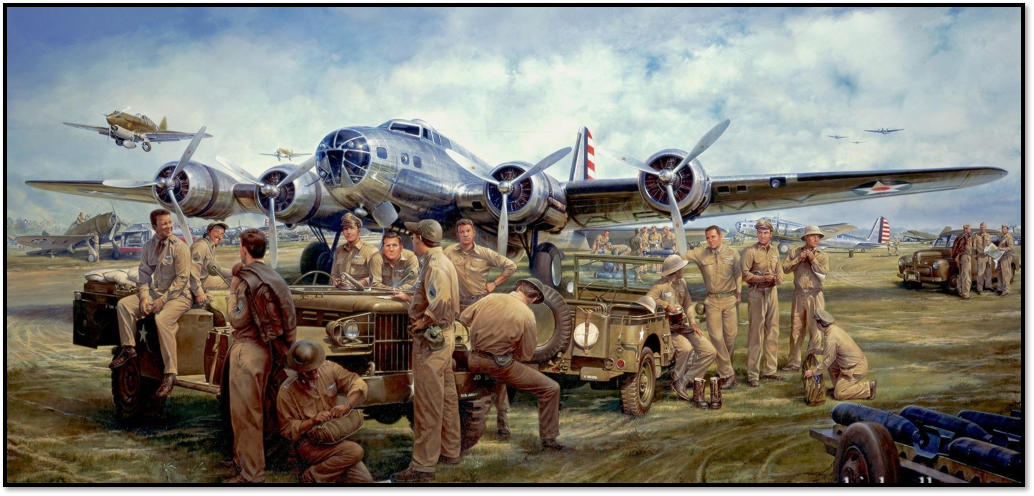
During the first six months of World
War II, the United States and our Filipino Allies fought with their backs to
the wall against the might of Imperial Japan. Immediately following the
Japanese attack on Pearl Harbor, across the international date line on December
8th, 1941, another offensive began on the U.S. Commonwealth of the
Philippines. For decades, the Americans planned for such an attack on their
outposts in the Far East; however, nothing went according to plan. With the
U.S. Pacific Fleet in shambles, allied positions in Singapore, Hong Kong, the
Dutch East Indies, Guam, and Wake Island under almost simultaneous assault, the
U.S.-Phil garrison on the Philippines found themselves behind the lines with
little hope of relief.
The
campaign for the Philippines (December 1941-June 1942) would echo into the
status of American military legends just like the Alamo or Valley Forge. U.S.
troops experienced the very worst warfare can offer, including starvation,
disease, brutal jungle combat and horrendous post-campaign captivity as
prisoners of war. Among the many brave and resilient soldiers, sailors, airmen,
and marines that fought in the initial defense of the Philippines from
1941-1942, one group stands out as a routinely forgotten group. These men often
forgotten to history are the grounded airmen of the Provisional Air Corps
Regiment (PACR). The PACR was a group of pilots, maintainers, Air Corps
administrative soldiers and more air base support personnel that became
infantry soldiers, and pilots of what would be known as “the Bamboo Fleet”.
Their exploits demonstrate an Air Force legacy that must live on.
The
PACR was a necessary creation out of desperation. In the opening stages of the
Japanese attack on the Philippines, General MacArthur’s Far East Air Force
(FEAF) was largely destroyed on the ground and by the end of December 1941,
most of those combat aircraft remaining in service were either shot down,
starved for spare parts, or evacuated to the safety of Australia. Just before
the entire FEAF was decimated, they possessed roughly 277 aircraft, 70 of them
pursuit aircraft such as P-35s and P-40s. After continuous bombing raids by the
Imperial Japanese Army Air Force and Naval Air Force, the FEAF shrank to
roughly 30 aircraft by December 10th. Succeeding the initial aerial
raids, the Imperial Japanese forces began to land all around the island of
Luzon throughout December, forcing General MacArthur to commit to the defense
of Bataan, a peninsula in Southwest Luzon, astride Manila Bay. After a
brilliant rear-guard action to hold the roads to Bataan open, the entire two corps-sized
element successfully evacuated into the Bataan Peninsula and manned a series of
defensive lines. The U.S.-Phil Divisions tasked to hold the line would do so on
low rations, water, low amounts of reserves, medical supplies, and limited
ammunition. The situation was dire, and no relief force was preparing to break
through to them.
Desperate
for a defensive posture, the PACR was officially formed in
the end of December 1941. The unit totaled 1,500 officers and ground crewmen
from the 20th Air Base Group, 19th Air Base Squadron, 27th
Material Squadron, 28th Material Squadron, 48th Material
Squadron, 7th Material Squadron, 27th Bombardment Group,
91st Bombardment Squadron, 17th Bombardment Squadron, 2nd
Observation Squadron, 34th Pursuit Squadron, 21st Pursuit
Squadron, 17th Pursuit Squadron, 3rd Pursuit Squadron, 24th
Pursuit Squadron and 20th Pursuit Squadron. The PACR was placed
under the command of General Parker in the II Corps sector as part of half the
Mauban-Abucay Line. Some of the men part of the PACR that were pilots also were
called in to form the “Bamboo Fleet”.
The
Bamboo Fleet was a collection of the remaining aircraft on Luzon that were
charged with providing air support, medical air evacuation, logistics
assistance, personnel transportation, aerial reconnaissance, and bombing raids.
This group of pilots from the PACR flew an eclectic group of 20 beaten up
planes to include five P-40s, one Grumman F2J4 “Duck”, two Bellanca CH-400
Skyrockets, one 1934 Waco UMF-3 Bi-Plane, two P-35s, four Beechcraft Model-117 Staggerwings, four O-49 Sinson Model-49, and one PT-130 “Kaydet”. As recalled
by the Squadron Commander of the 21st Pursuit Squadron, Captain
William “Ed” Dyess,
Cut
off from any land supply, blockaded by sea and with no conventional military
airlift assts available, brave Airmen under extremely austere and grueling
conditions displayed the hardiness of spirit to procure maintain and fly an
eclectic group of military and civilian aircraft dubbed the Bamboo Fleet.
This
jungle air insurgent force represented what Airmen are capable of when placed
in an almost impossible situation. The Bamboo Fleet supported many combat
actions previously unknown to the American public, one of which being Captain
Ed Dyess’ attack on Japanese Forces at Subic Bay. Captain Dyess and others had
received the intelligence report that three 12,000-ton tankers along with
transport ships, a cruiser and some destroyers were pulled into Subic Bay on
the western coast of Luzon. Captain Dyess made three bombing runs in one day.
His first flight followed Lt John Posten who in his P-40 had dropped six-small
fragmentation bombs on the Imperial Japanese at Grand Island. Captain Dyess
flew a P-40 Warhawk that was hung with a 500-pound bomb. On his approach he
flew in across the mountains of Luzon as you can see in the picture of the left. During Captain Dyess’ first run his 500-pound
bomb missed one of the larger ships he was aiming for, so he turned around and
staffed the Japanese forces until he ran out of ammunition.
After
returning to Bataan Airfield, Captain Dyess and his crew found that he had two
large holes in his wings and a third smaller one from anti-aircraft fire. While
waiting for his plane to get repaired Captain Dyess sent Lt Sam Grashio to make
his own bombing run with small fragmentation bombs on Grand Island. Lt Grashio was joined by two other pilots from Mariveles that were sent by Captain Joseph Moore.
On
Captain Dyess’ second flight to Subic Bay he took the same route, climbed to
10,000 feet and dove at a near 45-degree angle to 2,000 feet to drop his second
500-pound bomb this time hitting one of the Japanese freighters and damaging
nearby barges as well. He then spun around to strafe the bay once again
damaging warehouses on Grand Island as well as some of the smaller 100-ton
vessels. Upon landing a second time Captain Dyess mentions that he and his crew
found several more anti-aircraft holes in his plane. Escaping safe and sound a
second time Captain Dyess reluctantly got the approval from General George the
air chief for a third flight to Subic Bay.
Captain
Dyess on his third flight, accompanied by Lieutenant John Burns, took the same
route as the previous two flights. He aimed his third and final 500-pound bomb
for the day at the enormous supply dumps that were on Grand Island – and with a
direct hit he destroyed these facilities. Before returning he and Lt Burns
strafed the Japanese once more increasing the total causalities and chaos on
the ground. In the aftermath of the Subic Bay raids the Bamboo Fleet had lost four of their P-40s to damage and were
unrecoverable as well as one of their pilots.
Although
the Bamboo Fleet had taken some losses, the damage inflicted on the Japanese
forces were much greater. In total the raid had destroyed large amounts of
Japanese supply stores, one 12,000-ton ship, beached another 12,000-ton ship,
sank two 100-ton ships, and damaged the vital supply docks in Subic Bay. This
damage was so significant to the Japanese that a report came later from “Radio
Tokyo” that they had thought the American’s had flown several four-engine
bombers with fighter escorts. This grew the impact that the Airman of the PACR
and the Bamboo Fleet had on the defense efforts on Luzon.
Unfortunately,
the heroic efforts of the PACR defending the island of Luzon as irregular
infantry troops, as well as the incredible feats conducted by the Bamboo Fleet,
could not stop the inevitable defeat. After months of fighting, flying,
starvation, and disease, the U.S. forces were surrendered by General King on
April 9th, 1942. This mass surrender began an event known as the
“Bataan Death March”. Roughly 75,000 prisoners were taken by the Imperial
Japanese and forced the American and Filipino POWs to march to camps north in
central Luzon. One of which was called Camp O’Donnell. On the way to the camp,
thousands of prisoners would be killed or die due to Japanese atrocities, injuries,
or sickness.
Even
though the story of the Provisional Air Corps Regiment ends with the surrender
in 1942, their story is still one of heroism during times of sheer desperation.
These airmen, both acting as infantry soldiers and exceptional guerilla pilots,
faced overwhelming odds and enabled the U.S. forces to hold out for a few extra
months due to their efforts. While the rest of the Allied powers struggled to
slow the Japanese supernova of expansion across the Pacific, the U.S.-Phil
Garrison on the Philippines held and threw Tokyo off its timetable for six
months. The PACR, their actions, and the horrific conditions that they faced in
captivity must not be forgotten to the dustbin of history. Their story is an
inspiration which adds to the enduring legend of the “Battling Bastards of
Bataan” and highlight a significant warning to warfighters today: Do not let this happen to you.
The
story of the Provisional Air Corps Regiment, the Airmen of the Bamboo Fleet and
the notable leaders such as Lt Col William “Ed” Dyess and Col David L. Hardee
are also displayed at the New Mexico Military History Museum, Santa Fe, NM. https://www.newmexicomilitarymuseum.com/post/lost-sky-the-grounded-airmen-of-the-provisional-air-corps-regiment
Author Bio’s:
Brendan Donnelly is a Fellow
with the Consortium of Indo-Pacific Researchers (CIPR). He has
an undergraduate degree in History with a double minor in Political Science and
Aerospace Leadership Studies from Bowling Green State University in Ohio.
Brendan additionally has a graduate degree in Global Security Studies with a
specialization in National Security from Angelo State University in Texas. He
has published multiple articles with the Consortium, Journal of Indo-Pacific
Affairs (JIPA), and Nova Science Publishing. Finally, he is also
featured as a moderator and guest on the Vanguard: Indo-Pacific podcast
series, has served as an academic mentor and contributed to international
publications such as The Rzeczpospolita and the Nepal Institute for
International Cooperation and Engagement (NIICE).
Grant Willis is a Fellow
with the Consortium of Indo-Pacific Researchers (CIPR). He
is a distinguished graduate of the University of Cincinnati’s AFROTC program
with a B.A. in International Affairs, with a minor in Political
Science. Grant has multiple publications with the Consortium, United
States Naval Institute’s (USNI) Naval History Magazine, Air
University’s Journal of Indo-Pacific Affairs (JIPA), Air
University’s Wild Blue Yonder Journal, Nova Science Publishing and Air
Commando Journal. Furthermore, he often featured guest speakers
on multiple episodes of Vanguard: Indo-Pacific, the official
podcast of the Consortium, USNI’s Proceedings Podcast, and
CIPR conference panel lectures available on the Consortium’s YouTube channel.
v Views are personal