
The Mecca Joint Defense Agreement Amidst Rising Tensions in the Middle East
By: Nassim Abbas Khan | September 27th, 2026
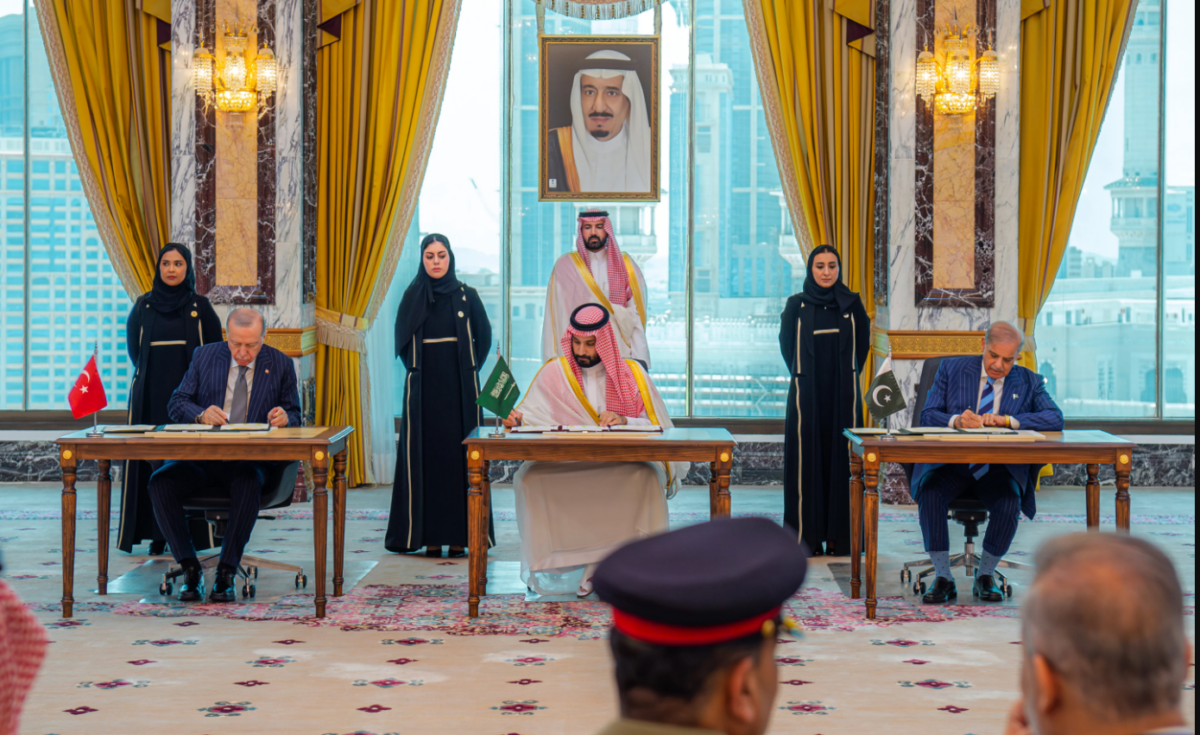
A landmark joint defense agreement was signed on 07 August 2026 between Pakistan, Saudi Arabia and Türkiye. The pact is considered a significant development in the evolving security architecture of the Middle East and South Asia. The pact contains a clause similar to NATO Article 5, which means that attack on any of the three signatories shall be considered an attack on all, without explaining any operational modalities. The agreement is open for more members to join, with some countries reportedly interested. The agreement has been largely hailed around the Muslim world, with some analysts foreseeing it as an emerging “Islamic NATO”, whereas others consider it an evolving collective regional security framework in the wake of declining trust in US security guarantees. Pakistan and Saudi Arabia have a similar defense agreement, which puts Pakistan into a two-fold obligatory situation. Regardless of its symbolic importance, economic, diplomatic and defense cooperation benefits for the three parties in peacetime, the pact can face serious implementation dilemmas during an active or impending military conflict in the Middle East. The pact, if enforced in letter and spirit under any evolving situation, could further complicate an already fragile security situation in the region. This requires the three signatories, especially Pakistan, to tread carefully and exercise extreme caution to avoid being sucked into a conflict that could potentially jeopardize the security of the entire region and beyond.
The agreement has come at a time when Middle East is embroiled in a complex turmoil. The signing ceremony took place in the Holy city of Islam-Mecca carrying implicit messaging of potential Muslim unity and mutual reliance. Although, the three signatories to the agreement have not named any common adversary which is common in such pacts, analyzing the agreement without keeping the ongoing Iran conflict, in perspective, would be naive. Also, Israel or any other regional country in the region seems to pose no direct threat to KSA, Türkiye or Pakistan. The pact has been signed at a time when US and Israeli military action to bring down the Iranian regime could not achieve all the desired results despite inflicting heavy human and material losses on Iran. The regime still survives. While Israel has militarily taken a step back with its own elections approaching, the US and Iran continue to exchange fire despite ongoing mediation efforts in the wake of the 14-point memorandum signed on 17 June to formalize cessation of hostilities. Iran seems defiant and vows to attack US bases/installations in the region being used to attack Iranian soil. It has also urged the regional countries not to let their soil be used against Iran. Recent Iranian attacks against Kuwait, Jordan and other gulf countries clearly show Iranian commitment to follow on its threats. Iran has declared the Strait of Hormuz closed while US forces claim to maintain blockade of the Iranian ports to inflict maximum economic losses. Oil prices in the international market have surged around $100 per barrel having a direct economic impact on the people around the world including the US. With mid-term US elections around the corner, Iran would get more leverage for a favorable deal if oil market continued to surge despite its own worsening economic turmoil. US on the other hand would prefer a relative calm with a decline in oil prices until the elections are over. The situation is likely to see a rapid and more violent escalation after the mid-term elections if a lasting deal is not reached and US, Israel and their Gulf allies decide to settle the Iran issue once for all. The US Vice President JD Vance has already said that “Iran war will enter a much different phase in a couple of months”
Besides its other declared objectives and benefits by the parties, the Mecca Defense agreement seems to be put in place, most likely with the US backing, to deter Iran and its proxies against any unwanted escalation in the Middle East. However, with the recent Houthi attacks on Saudi oil and military installations the situation seems to be escalating pretty early that could put the tri-party defense pact under severe stress and test. KSA and Iran-aligned Yemeni Houthis have had an uneasy relationship since the UN brokered truce in March-April 2022 and subsequent blockade on Houthi controlled areas of Yemen. The bombing of Sana international airport by the Saudi-backed Yemeni forces aircraft on 13 July 2026 to reportedly prevent an Iranian aircraft from landing in the Houthi controlled territory, became the flash point of recent round of hostilities. The Houthis interpreted the Saudi action as an attack and responded with missiles toward southern Saudi Arabia, including Abha. Mutual exchange of attacks has continued since then reaching a new high when Houthis knocked out one of the Kingdom’s most important oil transport routes, the East-West Pipeline across the Arabian desert. Officials from a Saudi-backed Yemeni government, say that the Saudi and Yemeni air forces have been responding to Houthi advances by stepping up aerial bombardment of Houthi targets. The Yemeni officials acknowledge that the Houthis have now taken effective control over almost the entire western coast of the country along the Red Sea.
Under the evolving volatile scenario, the Mecca Agreement tends to invite more questions than it offers any tangible solutions to the prevailing security dilemma of the Middle East. Pakistan and Türkiye have been quick to condemn the attacks in strongest terms without hinting at any military measures. Turkey has reiterated that the agreement is not aimed at Iran whereas Pakistan says it will not affect its ties with Iran. Pakistan foreign ministry said that there were no discussions about a military reaction from Islamabad under the Mecca agreement in response to the Houthis’ attacks on Saudi Arabia, but added that Pakistan would act when the "time comes": a point worth-noting. Pakistan’s Defense Minister Khawaja Asif said any attack on Saudi Arabia could activate the recently signed Mecca Joint Defence Agreement, and that “There should be no doubt about that. We are bound by the terms and conditions of this pact, and … we will honor them in case there is a need.” Earlier statements from the three signatories specified that the accord is “intended to strengthen collective deterrence against any act of aggression.” The question was: Deterrence against whom? Iran, Israel, non-state actors, or someone else? The answer was not altogether clear until now. The recent escalation between Houthis and KSA has cleared the ambiguity. The pact is expected to deter any destabilizing of the region from Houthis or any other player. But what happens if the “collective deterrence” fails?
While operational parameters and coordination mechanisms are being worked out by the three signatories, Türkiye and Pakistan have not yet indicated any direct military involvement to defend Saudi Arabia. It is important to note that Pakistan has also been coordinating the peace talks between the US and Iran along with Türkiye and Qatar. Both Pakistan and Türkiye have reasonably strong ties with Iran and would not like to be part of a larger conflict in the Middle East as it does not serve their own vital national interests. Pakistan also has to assess its internal security situation and possible fall outs before becoming party to a Middle Eastern conflict. Pakistan is also bound by another mutual defense pact with KSA signed last year which puts its leadership under immense pressure to deliver on the expectations of its partner. Turkey on the other hand is an important NATO member and its involvement in any conflict outside NATO could mean possible expansion of the scope and scale of any crisis.
While the situation is still evolving with a potential to spiral to a limit where either Pakistan or Türkiye are forced to intervene directly: a potential crisis that could destabilize the entire region and beyond. The important question is at what point would Pakistan or Türkiye be compelled to act? Would it be complete closure of Bab Al Mandab, a reasonable degradation of Saudi energy infrastructure? No one knows the answer yet. However, any attack on the holy city of Mecca from “known or unknown” quarters would definitely provide enough “casus belli” for Pakistan and Türkiye to convince their masses about the legitimacy of their compulsive involvement. The situation is already moving in the same direction. A drone was shot down by Saudi air defenses south of the holy city of Mecca on the eve of 15 Sep 2026 garnering widespread condemnation across the world especially from the Muslim countries. Pakistani Prime Minister was quick to condemn the attack in the strongest terms while vowing to stand shoulder to shoulder with KSA in defending its sovereignty and the Holy sites. Saudi authorities have declared the holy sites as their red line and claimed that it was a Houthi drone while Houthis have categorically denied the allegation reiterating that the Houthi forces pose no threat to the city of Mecca or other Islamic holy sites. There are already unconfirmed reports from different twitter “X” handles claiming that Pakistan and KSA have already activated the agreement with no official announcements. Pakistan has delivered a Saudi warning to Iran to rein in its Yemeni Houthi allies after they stepped up attacks on the kingdom, Iran’s reported response was that "Iran does not control the Houthis". If the situation continues to escalate, there may come a point where KSA asks Pakistan to stand by its commitments and play a more active role. That would be a great dilemma for Pakistan, a question of “to be or not to be” considering its close ties with Iran. Similarly, any active Turkish involvement could further worsen the situation and expand the scope of the conflict. Therefore, Pakistan and Türkiye must tread carefully and use their influence and existing relationship with Iran to diffuse the situation instead of being pushed into a conflict that does not serve their own vital national interests.
The Mecca defense agreement faces immense pressure and a real test under the evolving security situation in the Middle East. It is for the sane minds in the three capitals to reassess and re-evaluate the situation carefully and use diplomacy to avoid a wider conflict which could affect the entire region and beyond. A continued and expanding conflict amongst the regional countries would not be beneficial for anyone involved: it could only lead to mutual destruction with a long-term instability to follow. Iraq, Afghanistan and Syria, if analyzed carefully, should serve as best examples.
Author’s Bio: Air Cdre (Retd) Nasim Abbas Khan is a senior writer and researcher at Consortium’s South Asia team, Chief Strategy Officer, Privia Security, NATO and Allied forces, Istanbul, Türkiye. Views are personal.