
Non-Standard
Aviation: The Bamboo Fleet Informs 21st Century Tactics
Brendan Donnelly | March 8th2026

The Indo-Pacific region has continuously
thrust problems onto militaries throughout history that have operated within it.
Encompassing the Indian Ocean, Pacific Ocean, thousands of islands and
geographic features, the region itself complicates any military logistic supply
chain. This is why, whichever nation controls the area, or the key areas
maintain such strategic dominance over any other state that wishes to use it.
These choke points include the South China Sea (SCS), Strait of Malacca, and
East China Sea (ECS). Today, the Peoples Republic of China (PRC) lays claim to
both the ECS and SCS, directly interfering with multiple Southeast Asian
nations maritime sovereignty and Exclusive Economic Zones (EEZ) identified in
the United Nations Convention on the Law of the Sea (UNCLOS). This situation represents
one of the most hostile geographic areas in the world. The PRC recognizes this
and has determined that their military, the Peoples Liberation Army (PLA) must
be prepared to enforce the PRC’s claimed sovereign territory by 2027 and
continue to pursue the PRC’s rejuvenation goals by 2049. What this will look
like can be derived from Chinese Admiral Lie Huaqing’s teachings about what a
modern Chinese Navy should look like. The PLA will maintain a consistent
strategic defense posture, operate and enforce Chinese control over the first
and second island chains, uphold national unity and maintain the capability to
win regional disputes.[2]
Each of these goals for the PLA inherently seeks to counter the opposing view
of a “Free and Open Indo-Pacific” (FOIP).
A Free and Open Indo-Pacific as a term
originated from Japan, but has evolved into the national policy for many
nations to include the United States, Japan, Australia, New Zealand and others
within the Association of Southeastern Asian Nations (ASEAN).[3]
Further, other states that also rely on the ECS and SCS also diplomatically
prefer and work towards a FOIP, such as the European Union, so that conflict
does not arise in the area and inflict economic damage at a global scale.[4]
Yet, even with the threat of economic impacts, the PRC and the United States
have both identified outwardly that they each will be prepared to face off
through military means if necessary. For the PRC, their military action would
include invading and taking over Taiwan and enforcing sovereignty over the
9-Dashed Line in the SCS. While the United States would protect Taiwan from a
Chinese invasion and defend a FOIP in the SCS from any Chinese aggression.
Thus, the U.S. Department of Defense (DoD) must be prepared if called upon to
operate in the Indo-Pacific region. This includes not only trained service
members and the right technology to support a large-scale conflict in the
Indo-Pacific region but also maintaining the support necessary for large scale
combat operations. This support will ultimately fall on the logistics supply
chain, and the U.S. military industrial complex to equip the U.S. service
members for any conflict that could occur.
Logistics is the name of the game for
the U.S. military in the Indo-Pacific as, unlike their Chinese adversary, the
Indo-Pacific demands that the United States traverse thousands of miles to
deliver food, supplies, and medical equipment to its forces by means traveling
in air, land or sea. Within the DoD, there are two Combatant Commands (CCMD)
that will have to take on the brunt of this issue. First will be the U.S.
Transportation Command (USTRANSCOM), as a functional CCMD they are assigned the
responsibility to work with the separate uniformed services to supply the
global U.S. force with the required equipment. Second, will be the U.S. Special
Operations Command (USSOCOM) as this command will be required to supply their
teams that are dispersed in unconventional locations with supplies that may be
in significantly difficult to reach areas, also known as Denied, Degraded,
Intermittent or Low-Bandwidth (DDIL) areas. This paper aims to identify a
critical historic example, the Bamboo Fleet, that sheds light on potential ways
that USTRANSCOM, USSOCOM and the supporting U.S. service members can think
about to assist with the grander logistics issue in the Indo-Pacific.
The Bamboo
Fleet 1941-1942
December 8th, 1941, the U.S. military
forces and Filipino forces based on Luzon in the Philippines archipelago,
learned that their fears had come true, that the United States was at war.
Having heard about the Japanese air attack at Pearl Harbor, U.S. Army Air Force
pilots were ready for their orders to launch and bomb Formosa (today known as
Taiwan), counter attacking Japanese forces that were staged there. Their
anticipation was not met by any such order, instead pilots were given the order
to launch and defend from oncoming Japanese aircraft that were headed to bomb
Luzon. As many aircraft had either launched early, or as they were at Clark
Field, lined up on the airfield prepared to launch, many pilots and aircraft
were unable to make it off the ground as Japanese bombers had surprised the
U.S. forces. “The Japanese managed to demolish a majority of the planes at
Clark Field, Nichols Field and Iba Field,” this destruction left the defending
U.S. and Filipino forces with a minuscule air force compared to the hundreds
that had been stationed their previously.[5]
Across the airfields, the American’s realized that they had lost munitions,
aircraft hangers, fuel and the aircraft themselves set ablaze after this
attack, decimating any land based airpower that they could use to repulse the
next phase of the Imperial Japanese plan.
A few days after the attack, on
December 10-12, 1941, the Japanese landed 10,000 soldiers on Luzon, that were
met with little land or air resistance.[6]
Immediately pressuring U.S. forces on Luzon, General Douglas MacArthur was
faced with a daunting decision whether to execute War Plan Orange – 3 (WPO-3)
or not. This plan was created as the final defense of Luzon and U.S. forces on
the Philippines where they would retreat to the Bataan Peninsula and the Island
of Corregidor to hold out and defend against the Japanese forces. For almost
two weeks, the Japanese faced resistance from the American’s and Filipinos on
Luzon, until December 23, 1941 when General MacArthur decided to execute WPO-3.[7]
Retreating to the Bataan Peninsula, the U.S. and Filipino soldiers defended a
total of 100,000 people, 78,000 military members and about 22,000 Filipino
civilians.[8]
Each person requiring food, medical supplies and military equipment.
Many air crew members, maintainers,
pilots and administrative airmen that served as part of the Army Air Force,
were pulled to become infantry to support the defensive lines around Bataan,
these airmen were called the Provisional Air Corps Regiment (PACR).[9]
The other pilots from 34th, 21st, 3rd, 17th, 20th and 24th Pursuit Squadrons
that were not part of the PACR, operated the Bamboo Fleet. “Cut off from any
land supply, blockaded by sea and with no conventional military airlift assets
available, brave Airmen under extremely austere and grueling conditions
displayed the hardiness of spirit to procure, maintain and fly an eclectic
group of military and civilian aircraft dubbed the Bamboo Fleet to ferry
supplies and personnel to and from Bataan and Corregidor”, these pilots
numbered between 12 and 15 that braved hazardous conditions to support the last
stand at Bataan.[10]
Captains Harold Slingsby, Dick Fellows,
Joseph Moore, Gus Williams, Ed Dyess, Ray Gehrig, Bill Bradford, Harvey
Whitfield, Samuel C. Grashio, Ben Irvin, John Posten and William Cummings made
up the daring team of pilots that provided essential air support to the U.S.
and Filipino forces on Luzon.[11]
These pilots operated a small fleet of military and civilian aircraft,
including five operational P-40 Warhawks, one Grumman F2J4 “Duck”, two Bellanca
CH-400 Skyrocket’s, one 1934 Waco UMF-3 Bi-Plane, two P-35s, four Beechcraft
Model 17 Staggerwings, four O-49 Stinson Model 49 and one PT-130 “Kaydet”.[12]
Many of these aircraft were patched up with native Philippine wood, or like the
“Duck” was literally pulled out from being semi-submersed after being destroyed
in the initial Japanese bombardment.[13]
Nonetheless, the pilots and aircraft pulled through to conduct a few different
types of operations.
As recalled by Dyess, “[…] the rest of
February, through March and up to the fall of Bataan in early April we flew
reconnaissance, brought in medical supplies from the southern islands with the
Bamboo Fleet, and dropped supplies to our guerillas who were fighting in the
mountains of Luzon.”[14]
Outside of reconnaissance and supply runs, the Bamboo Fleet with their P-40s
and P-35s went on a few bombing missions, attempting to degrade any additional
Japanese landings on Luzon. During these bombing missions, the Bamboo Fleet
used homemade delivery mechanisms that carried 30-, 100-, 300- and 500-pound
bombs.[15]
Every day the Bamboo Fleet found themselves flying nighttime missions. “The
dangerously overloaded planes took off at dusk on hair-raising flights timed to
reach their objective just as dawn was breaking. Sometimes missions were so
urgent that the pilots had to fly during the day. When that happened, they
would island-hop, flying at an altitude of no more than 500 feet, often just
100 feet above the water’s surface”.[16]
These missions were meant to provide air support to soldiers on the ground, or
run logistics operations, but the critical mission was bring the aircraft back
to the airfields so that it could continue flying.
The resourcefulness of these pilots and
their maintenance crew members, enabled the evacuation of between 100-120
personnel to Australia who would either be sent to the European theater to
support air operations, or were kept in the Pacific to assist the U.S.
operations in the Southern Pacific.[17]
Additionally, the Bamboo Fleet was able to provide medicine, food and supplies
that not only assisted with the defense of Bataan but also saved lives overall.[18]
Uniquely, the Bamboo Fleet also assisted with boosting morale, as American’s
that heard the engines of the Bamboo Fleet latched onto the hope of survival
that these pilots brought, as well as the candy that they could bring. Capt
Moore in the “Duck” was able to bring candy along with him that boosted the
spirits of nurses on Bataan and those that the candy made its way to, giving
the ”Duck” the name “The Candy Clipper”.[19]
Although the Bamboo Fleet flew every day and continued to bring supplies for
the defense at Bataan, unfortunately the U.S. and Filipino forces at Bataan
were forced to surrender to the Japanese on April 9th, 1942. Even so, this
historic example identifies a few key aspects that can inform USTRANSCOM and
USSOCOM of the opportunities that Non-Standard Aviation (NSAV) can bring to
combat operations in the Indo-Pacific region today.
Non-Standard Aviation Today
Today there are a few aircraft that
support that vast majority of logistics missions for USTRANSCOM and USSOCOM.
Within USTRANSCOM the heavy hitters regarding aircraft include the C-5 Galaxy,
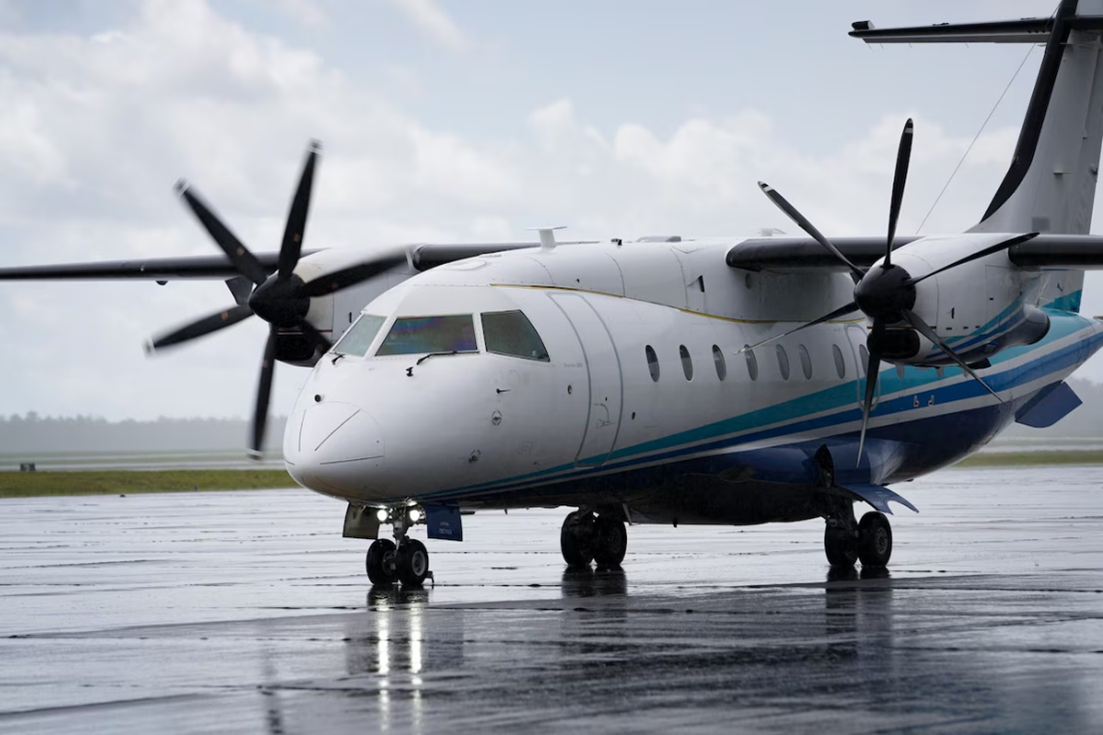
C-17 Globemaster III and the C-130 Hercules. While within USSOCOM their NSAV
mission includes the M-28 Skytruck, Q-200, and C-146A Wolfhound.[20]
The USSOCOM aircraft are typically painted in civilian schemes to provide a
more clandestine profile and make them look less like military aircraft.[21]
These are the bulk of airborne logistics operations that could be seen in the
Indo-Pacific region. Yet each of them has a significant disadvantage when
operating against the PRC in the DDIL environment during wartime operations.
This disadvantage is that aircraft like the C-5 and C-17 are large targets the
PLA would see as High Valued Air Assets (HVAA) since they both can carry a
significant amount of people or logistics. As for the USSOCOM NSAV aircraft,
they are each associated with special operations and therefore could be seen as
high valued assets for the PLA to engage. Herein lies where the Bamboo Fleet
can identify a supporting capability in the 21st Century.
Throughout the existence of the Bamboo
Fleet even with the small number of aircraft the pilots still produced a
significant impact to the livelihood of those on Bataan. These same impacts of
non-standard aircraft resonate later during the Vietnam conflict as well. U.S.
Military Airlift Command looked back at the Vietnam War through Project Corona
Harvest and concluded that “commercial augmentation was an effective means of
expanding the DoD airlift capability in those cases where military airlift
capability was diverted to higher priority military tasks […]”.[23]
Commercial aircraft contracted to support military operations can provide a
flexibility to air commanders while protecting their critical assets in the
Indo-Pacific.[24]
Furthermore, without flexible airborne logistics capabilities, a poor logistics
chain will be unable to support the commander and all other military operations
become irrelevant.[25]
NSAV within the Indo-Pacific region can
assist in ensuring the U.S. logistics chain can be responsive, flexible and
sustainable using small commercial aircraft to transport or airdrop critical
equipment, medical supplies, and food to U.S. service members dispersed
throughout South East Asia (SEA).[26]
For consideration, some of the aircraft that are common in SEA include Cessna
208, Cessna 172, DHC-6 Twin Otters, Airbus H225 & H215, Diamond DA42 Twin
Star, numerous variants of Cessna and similar commercial aircraft.[27]
These fixed wing and rotary wing aircraft still have a place in warfare and can
provide a unique capability that larger military aircraft cannot. Although they
are limited on the amount of weight they can carry, light weight medical
supplies, Meals Ready to Eat (MRE), or other equipment that could be life
changing in combat could be delivered to U.S. service members out in the field
or to special operations teams using airdrops. Another advantage that small
commercial aircraft provide other than clandestine opportunities is to force
the PLA to question their strike using a Surface-to-Air-Missile (SAM). As an
example, a Cessna 172 brand new costs $400K, but many in the SEA are older and
likely cost closer to $60K.[28]
While the Cessna 172 could be airdropping essential supplies to U.S. service
members or is landing to supply an airbase part of the Agile Combat Employment
(ACE) scheme of maneuver. The PLA must make a few critical decisions, first
being, is it worth a multi-million-dollar SAM launch from something like an
HQ-12, HQ-16, or HQ-9 to destroy a highly replaceable commercial aircraft?[29]
Or is it more effective towards their war effort to save those highly advanced
SAMs for more significant targets operated by the U.S. military?
These are the critical questions that
are thrust upon the PLA and the PRC when NSAV is effectively used by the U.S.
military. Not only is there likely to be hesitant to use a highly sophisticated
asset on a low payoff target, but the PLA will also have to weigh the cost of
launching at a commercial asset. The PLA will additionally be pressed with
military consequences but potentially diplomatic ones as well when NSAV is
used. Therefore, it is imperative to identify the key benefits to using NSAV.
Many SEA nations such as the Philippines, Thailand, Indonesia, Vietnam,
Malaysia and Laos have many different types of small commercial aircraft that
could be relied on during wartime operations to support U.S. service members
and special operations forces. Additionally, NSAV enables air commanders with a
unique method of logistics delivery that can succeed when normal forms of
aerial supply have failed or are placed at too high of a risk.[30]
Finally, NSAV can alleviate some pressure off U.S. military assets and can
permit them to execute logistics operations for higher priority locations thus
enabling the flexibility of total air power in theater.
Summary
Overall, NSAV is not a panacea for aerial
logistics, but does provide a unique air power opportunity that can support
both USTRANSCOM and USSOCOM if they ever must conduct wartime operations in the
Indo-Pacific region. The Bamboo Fleet is an excellent historic example of how
small aircraft can produce significant change to the battlefield unlike nothing
else. Further, the lessons learned identified from the Military Airlift Command
further support the Bamboo Fleet example and press the idea of NSAV as a
tactical and operational answer to intra-theater aerial logistics support.
Finally, the operational benefits that NSAV bring up to wartime operations both
support ACE operations and special operations units, while also creating
another issue for the PLA to handle while repulsing U.S. military forces.
Author Bio:
Brendan
Donnelly has been a research fellow with the Consortium of Indo-Pacific
Researchers since 2021. He has a bachelor’s degree in history and a double
minor in political science and aerospace leadership from Bowling Green State
University. Brendan also has a graduate degree from Angelo State University in
global security studies, with a focus area on national security. He has made
many notable contributions such as to the book Southeast Asia and the
Indo-Pacific Construct and with the Rzeczpospolita (The Republic). Brendan
has also published articles with the Air University Press and designed a museum
exhibition with the New Mexico Military History Museum in Santa Fe.
[1]
Dwight Jon Zimmerman, “The “Bamboo Fleet” Shuttle Service to Corregidor”, Defense
Media Network, (February 16, 2012), https://www.defensemedianetwork.com/stories/on-a-wing-and-a-prayer-the-%E2%80%9Cbamboo-fleet%E2%80%9D-shuttle-service-to-corregidor/.
[2]
James R. Holmes and Toshi Yoshihara, Chinese Navl Strategy in the 21st
Century: The Turn to Mahan, Routledge Taylor & Francis Group, (2008).
[3]
Leszek Buszynski & Do Thanh Hai, Maritime Issues and Regional Order in
the Indo-Pacific, Palgrave Macmillin, (2021).
[4]
Nicola Casarini, “Assessing Europe’s Perspectives on the South China Sea”, Maritime
Issues and Regional order in the Indo-Pacific, Palgrace Macmillan, (2021).
[5]
Nene Sims, “The Events that led to the Fall of Bataan and to the Death march
made by the Defending Filipino and American Troops”, Rice University,
(August 1977).
[6]
Ibid.
[7]
Nene Sims, (August 1977).
[8]
Ibid.
[9]
Brendan HJ Donnelly and Grant Willis, “The Provisional Air Corps Regiment at
Bataan, 1942: Lessons for Today’s Joint Force”, Journal of Indo-Pacific
Affairs, (August 25, 2021), https://www.airuniversity.af.edu/JIPA/Display/Article/2743809/the-provisional-air-corps-regiment-at-bataan-1942-lessons-for-todays-joint-force/.
[10]
John F. Farrell, “The Bamboo Fleet: How a Ragtag Airlift Operation Supported
Besieged U.S. Forces in the Philippines in World War II”, Air Power History,
vol 59, no 2, (Summer 2012).
[11]
William H. Bartsch, “I wonder at times how we keep going here”: The 1941-1942
Philippines Diary of Lt John Burns, 21st Pursuit Squadron”, Air
Power History, vol 53, no 4, (Winter 2006); Lt Col WM. E. Dyess, The
Dyess Story, GP Putnam’s Sons, (1944).
[12]
Nene Sims, (August 1977) ; Dwight Jon Zimmerman, “The Bamboo Fleet Shuttle
Service to Corregidor”, Defense Media Network, (February 16, 2012), https://www.defensemedianetwork.com/stories/on-a-wing-and-a-prayer-the-%E2%80%9Cbamboo-fleet%E2%80%9D-shuttle-service-to-corregidor/;
John F. Farrell, vol 59, no 2, (Summer 2012).
[13]
Capt Roland J. Barnick, “The Bamboo Fleet in Air Force Diary: III Stories from
the Official Journal of USAAF”, e.d. Col James H. Straubel, New York Simon
and Schuster, (1947), pg. 251; Bob Stahl, “Fugitives: Evading and Escaping
the Japanese”, The University Press of Kentucky, (2001).
[14]
Lt Col WM. E. Dyess, (1944) pg. 47.
[15]
Lt Col WM. E. Dyess, (1944) pg. 47.
[16]
William H. Bartsch, “Every Day a Nightmare: American Pursuit Pilots in the
Defense of Java 1941-1942”, Texas A&M University Press, (2010).
[17]
Wesley Frank Craven and James Lea Cate, eds., “The Army Air Forces in World War
II”, vol 1, Plans and Early Operations, January 1939 to August 1942,” Washington
DC Office of Air Force History, (1948), pg. 405.
[18]
Ibid.
[19]
National Museum of the USAF, “Grumman OA-12 Duck”, National Museum of the
United States Air Force, https://www.nationalmuseum.af.mil/Visit/Museum-Exhibits/Fact-Sheets/Display/Article/196903/grumman-oa-12-duck/.
[20]
American Special Operations, “USAF Special Operations – Non-standard Aviation”,
American Special Operations, https://www.americanspecialops.com/usaf-special-operations/intra-theater-aircraft/.
[21]
Ibid.
[22]
United States Air Force, “C-146A Wolfhound”, United States Air Force,
(January 2025), https://www.af.mil/About-Us/Fact-Sheets/Display/Article/467729/c-146a-wolfhound/.
[23]
Warren H. Delker, Brig. Gen. James A. Hill, Gen. Jack J. Catton, “A Military
Airlift Command Activity Input to Project Corona Harvest on Strategic Airlift
in SEA 1 April 1968 – 31 December 1969” vol 1, Military Airlift Command, (November
1, 1970), pg. I-I-27.
[24]
Ibid.
[25]
Chairman, Joint Chiefs of Staff, “Joint Publication 4-0: Doctrine for Logistics
Support of Joint Operations”, Washington D.C., (January 27, 1995), pg.
I-6.
[26]
Maj John A. Tokar, “Provide by Parachute: Airdrop in Vietnam, 1954-1972”, School
of Advanced Military Studies United States, Army Command and General Staff
College, (December 14, 1999).
[27]
Military Factory,” Philippines Aircraft List: Current and Former Types”, Military
Factory, https://www.militaryfactory.com/aircraft/by-country.php?Nation=Philippines.
[28]
Patricia Green & Dr. Omar Memon, ”The Cost of Owning & Operating a
Single Engine Cessna”, Simply Flying, (May 22, 2024), https://simpleflying.com/cessna-private-ownership-costs-explained/#:~:text=A%20new%20Cessna%20172%20Skyhawk,year%20and%20the%20aircraft’s%20condition.
[29]
Nations: Dawn of an Era, “Surface to Air Missiles Systems”, Nations: Dawn of
an Era, https://nations-militaryequipmentlist.weebly.com/anti-air-systems.html;
OE Data Integration Network, ”HQ-16 (HQ-16A) Chinese 6×6 Medium-Ragne
Surface-to-Air Missile System” ODIN – OE Data Integration Network, https://odin.tradoc.army.mil/WEG/Asset/HQ-16_(HQ-16A)_Chinese_6x6_Medium-Range_Surface-to-Air_Missile_System.
[30]
Maj John A. Tokar, December 14, 1999.