
Outcome of India-Russia Summit and
Implications for the Indo-Pacific
By: Indu Saxena & Hayat Alvi | December 14th, 2025
Russian
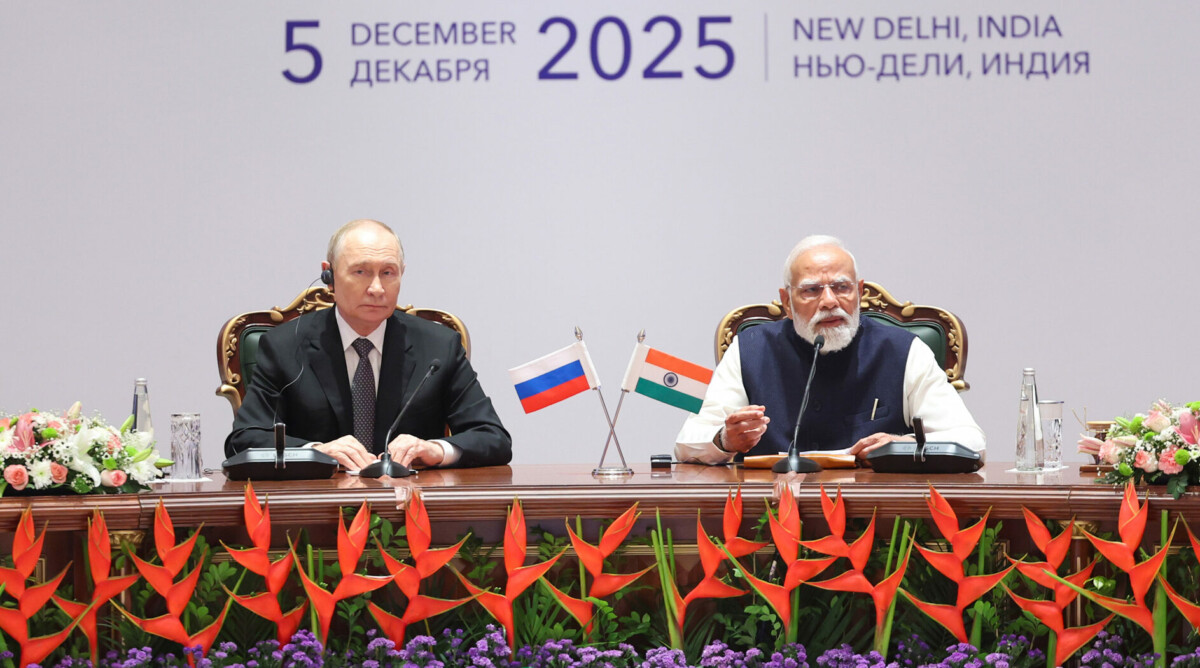
President Vladimir Putin’s visit to New Delhi at the invitation of Indian Prime
Minister Narender Modi marked a significant moment in India-Russia relations
amid chaotic world politics. Putin’s grand welcome in India demonstrates
further expansion of the “time-tested” and “privileged strategic
partnership” between the two countries. Modi and Putin signed a joint statement and reaffirmed their commitment to
enhance cooperation in trade, defense, energy, transport, space, science and
technology, civil nuclear initiative, cultural, tourism, and people-to-people
exchange.
The
highlights of Putin’s visit to India included setting the bilateral trade
target of USD 100 billion by 2030. Russia’s assistance in helping India achieve
a nuclear power capacity of 100 GW by 2014 would be highly significant.
Additionally, India will import fertilizers from Russia, while Russia will
source Indian pharmaceuticals and agricultural products. In his speech, Putin
stated that Russia intends to supply “uninterrupted oil” to India. However,
it remains uncertain whether India will increase its oil purchases. Conversely,
India has decreased its oil imports following pressure from US President Trump.
Over the
past two decades, the United States’ strategic rebalancing toward Asia—embodied
in its “pivot to Asia” and “Indo-Pacific strategy”—has
significantly transformed India–US relations. India is recognized as a ‘major
defense partner, a natural ally, and participates in a comprehensive global strategic
partnership
with the United States. Additionally, India is a key member of the U.S.-led
Quad grouping, which seeks to counterbalance China’s influence in the
Indo-Pacific region. This raises the question of how India can balance its
relationship with Russia while remaining a key member of the Indo-Pacific and
Quad partnership.
When the
Ukraine war started in early 2022, many strategic thinkers, particularly from
the West (US and Europe), observed that the Russia-India partnership is linked
with India’s reliance on Russian military equipment, which constitutes of its
70 % of arsenal. And it would gradually diminish as India started diversifying
its arms supply from the US, France, and Israel, and India’s domestic
production “Make in India” program. That didn’t hold, India still has
about 80 billion USD in defense imports from Russia. Additionally, India’s key
focus may now be on the procurement of next-generation, Russian air defense systems, the
S-500 platform.
Notably, the
Russian S-400 defense system was utilized to protect from drone attacks
launched by Pakistan during Operation Sindoor in May 2025. Notwithstanding,
expanding on this contract, India may face US sanctions under the provisions of
Countering America’s Adversaries Through Sanctions Act (CAATSA).
Another
challenge will be coming up with the BRIC presidency in 2026. President Trump
perceives BRICS and its development, such as “BRICS Pay,” moving away
from the dollar and promoting industrial development among its members and in
the Global South, as a direct threat to America’s national interest. However,
both India and the US want to improve trade relations soon and seek to
strengthen bilateral relations. India has to carefully
manage its relations with Washington at the bilateral level, particularly while
holding the torch of BRICS presidency next year.
Furthermore,
the US National Security Strategy (NSS)
2026, rooted in the “America
First” principle, recognizes India as a significant partner in the
Indo-Pacific region. The NSS states, “We must continue to improve
commercial (and other) relations with India to encourage New Delhi to
contribute to Indo-Pacific security, including through continued quadrilateral
cooperation with Australia, Japan, and the United States (“the
Quad”). The United States seeks to expand commercial and other forms of
engagement with India to further enhance the US-India relationship.
However, the United States recently expressed concerns over
India’s continued importation of Russian energy supplies, viewing such
transactions as counter to American efforts to isolate Russia economically. By
introducing punitive tariffs, the administration may have sought to signal its
disapproval and encourage India to reconsider its energy alignments. However, official statements primarily cited
trade and security issues as the main justification for these actions, rather
than explicitly linking tariffs to India’s energy dealings with Russia. Still, India has to
exact a delicate balance in relations with the United States concerning India’s
transactions with Russia.
Again, the US South and Central Asia Subcommittee Chairman Huizenga
states that America’s
partnership with India is a “critical” and “defining relationship of the 21st
century” to establish a democratic, value-based, free, and open Indo-Pacific.
Chairman Huizenga emphasized that the US representatives from both side of
aisle have worked to strengthen the relations and noted that Putin’s “warm
visit” to India and Modi’s presence in the Shanghai Cooperation Organization
(SCO) this September raised “understandable concerns.” He anticipates that a
new trade deal would enhance the US-India partnership.
India has to walk on
a tight rope to sustain cordiality in India-US relations. India’s sovereignty
and strategic autonomy provide it with the capacity to pursue a multi-aligned
approach. However, as India expands its relations with Russia, it is important
to exercise caution and maintain a delicate balance, particularly in managing
its broader interests with the United States in the Indo-Pacific region. It is
conceivable that Modi and Trump may serve as each other’s guests in 2026, with
the United States hosting the G-20 summit and New Delhi presiding over the Quad
summit.
Author’s Bio:
Dr. Indu Saxena is Senior Fellow & Chief Operation Officer at the
Consortium of Indo-Pacific Researchers. She writes on U.S. India Relations,
South Asia, Southeast Asia, and Indo-Pacific Security. She writes “Indo-Pacific Weekly Mail,” a
weekly newsletter on the Indo-Pacific region.
Dr. Hayat Alvi is
an Associate Professor and the Khaled Chair in Political Science and
International Policy, at Auburn University, Montgomery, Alabama. Previously, she served as an Associate Professor at the
US Naval War College, Newport, Rhode Island.
v Views are personal